




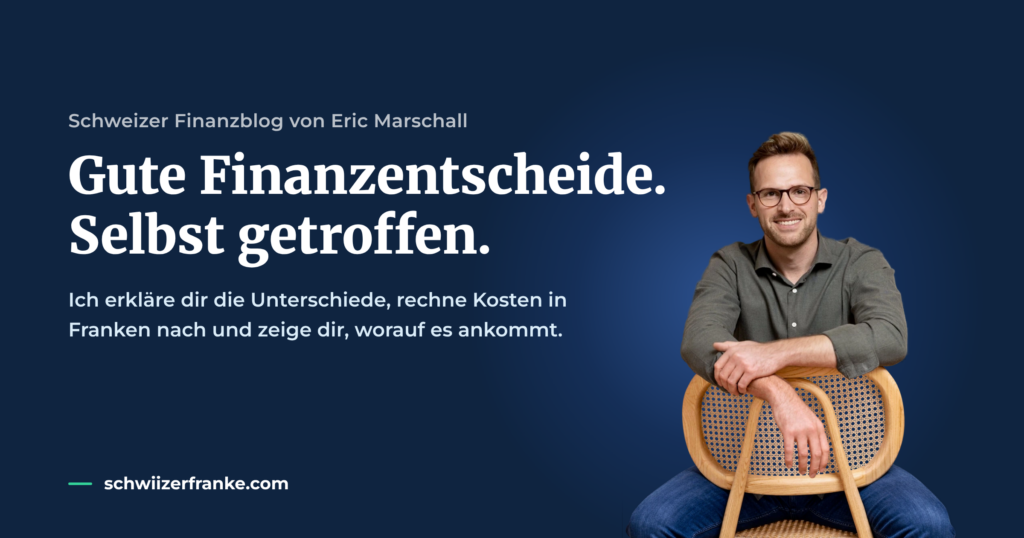
My most costly financial mistake wasn’t an investment. It was a piece of tax advice.
When I first arrived in Switzerland, I wanted to do everything by the book. As a foreigner, I was subject to tax at source at the time: the tax was deducted directly from my wages, so I didn’t need to file a tax return. Nevertheless, I paid for independent tax advice. Their advice was to make contributions to a Pillar 3a pension plan and save on tax that way. To do this, I had to submit a tax return for the first time. Years later, I did the maths myself: on balance, I ended up paying several thousand francs more in tax.
Pillar 3a makes sense for most people. Nevertheless, the advice was wrong, as the adviser did not check whether the recommendation was suitable for my situation.
That’s exactly what you want to avoid. That’s why Schwiizerfranke is here: to help you understand finance in Switzerland and make sound financial decisions for yourself.
Eric, founder of Schwiizerfranke
Our seven principles
We write our articles, build our computers and evaluate suppliers in line with these principles. For each one, we explain exactly what this means for you.
1. First your situation, then the tip
A good tip for the wrong person is a bad tip.
Most financial tips are rules of thumb. They apply to many people, but not to everyone. A Pillar 3a pension scheme is worthwhile for most people. However, if you pay little tax or will need the money in a few years’ time, you’ll gain little benefit, as the money is usually tied up until shortly before retirement. And owning your own home isn’t always worthwhile – for example, if you want to remain flexible or if the deposit uses up your entire savings.
Your own figures are better than any rule of thumb. That’s why we’re building free calculators, which you can use to check a tip relating to your situation, for example whether Buying rather than renting is worth it for you.
What this means for you: We’ll show you not only the advantages, but also the main limitations and drawbacks.
2. Safety first, then returns
You should only invest money that you won’t need in the long term. Before that, there’s a emergency fund for unexpected events, such as a car repair or a period of unemployment. And money that you’re sure to need over the next few years – for example, for a car, further training or tax bills – doesn’t belong on the stock market. The reason is this: if you have to sell at the wrong moment, you’ll incur a permanent loss on the share price. That’s why, for us, how much you could lose is just as important as the potential return.
What this means for you: No comparison and no starting bonus can replace this order.
3. Each investment objective has its own equity allocation
It’s not you who has an equity allocation. Every objective has one.
If you’re retiring in 30 years’ time, you’ve got time to ride out a stock market crash. But you might not have that luxury if you’re buying a flat in five years’ time. That’s why this money should be invested differently. So the question isn’t just whether you’re a bold or cautious investor. It’s also about when you’ll need the money and how much of a loss your investment can withstand until then.
What this means for you: Too much risk? Then check your equity allocation first, not the ETF.
4. Invest for the long term rather than trying to time the market
When you buy shares, you become a co-owner of a company and share in its profits. If companies generate profits and grow over the long term, their shares may also increase in value. However, the actual return you achieve also depends on the price at which you buy. Crises are part and parcel of this. Historically, broadly diversified stock markets have recovered even from severe crises. However, this can take many years, and there is no guarantee that this will happen in the future. That is why, for us, ‘long term’ means: a pure share portfolio should only contain money that you won’t need for at least ten years. That way, you’ll sleep better and be able to ride out the fluctuations. If you need the money sooner, opt for a lower equity allocation – see Principle 3. Money in a savings account, on the other hand, quietly loses value as soon as inflation exceeds the interest rate.
Nobody knows the right time to get started. If you wait for the right moment, you risk missing out on rising prices. That’s why we don’t rely on timing, but instead recommend a savings plan where you invest a fixed amount every month, or a one-off investment that you leave to grow.
What this means for you: The question isn’t whether you should invest now, but with what money and for what purpose.
5. We buy into the market rather than trying to pick winners
Nobody knows which share or which country will come out on top over the next ten years. That is why we opt for ETFs. An ETF is a fund that is traded on the stock exchange. But not all ETFs are the same. We’re talking about ETFs that track a broad index – for example, shares from around the world or from Switzerland – without leverage and with low costs. A single purchase of such an ETF allows you to invest in hundreds or thousands of companies. To see exactly how this works, take a look at Which ETF is suitable for beginners?.
We are particularly cautious about three types of investment:
- Individual shares: To achieve broad diversification, you therefore need a substantial amount of capital and plenty of time. They are therefore not a suitable foundation for a beginner’s investment portfolio.
- Cryptocurrency: It isn’t necessary. In our view, anyone wishing to include crypto should look at Bitcoin limit it, and only to a small proportion. No altcoins, no trading.
- Crowd investing and crowd lending: The risk of default is higher with private equity investments and loans. It is often difficult, or even impossible, to exit early. With equity investments, your percentage stake may also decrease as a result of subsequent funding rounds. We therefore view these investments with scepticism when it comes to simple, long-term wealth accumulation.
6. Swiss investors need Swiss answers
The Swiss franc, Pillar 3a, pension funds, stamp duty and withholding tax mean that things work quite differently here than in Germany or the US. Much of the financial advice available online originates from those countries and is only partially applicable here. You should therefore check whether a piece of advice applies to Switzerland before you act on it. Here’s an example: investing in Swiss shares saves you exchange rate fees and, in some cases, tax. That’s why we believe your investment portfolio should include some Swiss assets, but not the majority, so that not too much of your wealth is dependent on the Swiss economy. Find out more at Investing money in Switzerland.
What this means for you: We use Swiss francs and follow Swiss rules.
7. Cost matters, but so does simplicity
Returns are never guaranteed. Fees, on the other hand, are.
Three things follow from this:
- Making costs transparent: We quote costs and calculate them in Swiss francs.
- More expensive only if it offers added value: A more expensive product has to offer you something in return – for example, a Swiss broker who provides you with a ready-made tax statement.
- Separating savings and insurance: Life insurance policies with a savings component, such as a 3a policy, are usually expensive and inflexible. However, a pure term life insurance policy can still be a sensible option.
And simple beats complicated: a strategy that you understand is easier to stick to, even during difficult periods on the stock market.
What this means for you: Where performance is comparable, we favour the cheaper and simpler solution. However, which provider is right for you depends on your needs. That’s why our comparisons highlight the differences rather than simply picking a winner.
How we assess financial products
These principles are also incorporated into our product comparisons. Where we award points and stars, we use fixed criteria, such as cost, range of investment options, flexibility and ease of use. These apply equally to all providers we review. We do not make up missing product data. Where information is missing, we either carry out further research or flag the gap.
If we also mention a personal favourite, we will explain the reasoning behind this choice separately. It does not affect the overall assessment. One example is the Pillar 3a comparison.
How we make independent judgements
Before we recommend anything, we ask ourselves: Would we recommend this to our friends and family? A product must win us over even if we don’t receive a commission for it. That’s the standard by which we measure our recommendations.
Schwiizerfranke generates revenue through, amongst other things, partnerships with providers. Whether a provider is a partner does not affect points, stars or rankings. Nor do existing partnerships prevent us from critically assessing products and clearly highlighting their drawbacks. Information on how we are funded can be found on the About page.
We’re always learning
Markets, products and legislation change, and sometimes our perspective changes too. When that happens, we update this page and note any significant changes. The information provided here reflects our views and does not constitute investment advice. You should therefore always assess our statements in the light of your own circumstances.
As at November 2026
Where’s the best place to start?
Do you want to know where you’re at and what’s next? Then get started with the Funding route.