




The 13th month’s salary is an additional month’s salary paid once a year. You calculate it as follows: the total of your monthly salaries for the year divided by 12. If your monthly salary is CHF 6,500, this amounts to CHF 6,500 gross.
With the 13th-month salary calculator, you can see the gross and net amounts, as well as the amount payable on joining or leaving the company. It calculates your monthly, annual or hourly pay and shows you the deductions just as they appear on your payslip.
Key points at a glance
- Formula: 13th month’s salary = total monthly salaries for the year ÷ 12.
- Not compulsory: You are only entitled to this if it is stated in your employment contract, the regulations or the collective agreement.
- Pro rata: Anyone who joins or leaves during the year will receive it on a pro rata basis, for example 7/12.
- Hourly wage: The proportion amounts to 8.33 % of the hourly wage.
- Deductions: AHV/IV/EO, ALV and NBU, as with a normal salary. Pension contributions are often missing because they are deducted in twelve instalments.
13th month salary Switzerland
The 13th month’s salary is very common in Switzerland. Many people therefore believe it is required by law. That is not true. It is simply a normal part of your salary that is paid out differently: instead of twelve monthly salaries, you receive thirteen.
Is the 13th month’s salary compulsory?
No. You are entitled to it if the 13th month’s salary is stipulated in your employment contract, in the staff regulations or in the collective labour agreement (CLA). In many sectors, the CLA stipulates this, for example in the hospitality industry or the construction sector. If your employer has paid it regularly and without reservation for several years, this may also give rise to an entitlement.
Whether your annual salary is paid in 12, 13 or even 14 instalments makes no difference to the total. An annual salary of CHF 91,000 is either 12 × CHF 7,583 or 13 × CHF 7,000. When comparing two job offers, you should therefore always base your calculations on the annual salary rather than the monthly salary.
13th month’s salary or a bonus?
The 13th month’s salary is a fixed agreed salary. A bonus, on the other hand, is a special payment in accordance with Article 322d of the Swiss Code of Obligations, the amount or payment of which may be at the employer’s discretion. The difference is important: a bonus may be subject to conditions, such as the employment contract remaining in force. This is not the case with the 13th month’s salary.
Colloquially, the 13th month’s salary is also known as a ‘Christmas bonus’, as it is often paid in December. In Germany, however, a Christmas bonus is usually a voluntary special payment – in other words, more of a gratuity.
Tip: If the contract states «13th month’s salary», it is payable. If it states «gratuity» or «bonus», read the terms and conditions carefully.
How to calculate the 13th month salary?
You can work out your thirteenth month’s salary using a simple fraction. Take all the monthly wages you’ve earned in the calendar year and divide them by 12. Whether you call it the 13th monthly wage, 13th wage, 13th salary or 13th monthly salary, you can always work it out in the same way.
13th month’s salary = 1/12 of the annual salary
13th month's wages = Annual salary excluding the 13th month’s salary ÷ 12 = Monthly salary × number of months ÷ 12
If you work all year on the same wage, the 13th month’s pay is exactly one month’s wage. If you only know your annual wage, including the 13th month’s pay, divide it by 13 to work out your monthly wage.
| Situation | Calculation | 13th month's wages |
|---|---|---|
| All year round, CHF 6,500 per month | 6,500 × 12 ÷ 12 | CHF 6,500 |
| Start date: 1 June, CHF 6,500 | 6,500 × 7 ÷ 12 | around CHF 3,792 |
| Termination with effect from the end of September, CHF 7,200 | 7,200 × 9 ÷ 12 | CHF 5,400 |
| Annual salary CHF 91,000 including the 13th month’s salary. | 91,000 ÷ 13 | CHF 7,000 |
Pay components such as holiday pay or continued pay in the event of illness are included. Overtime, child allowances, expenses, commissions and bonuses are not usually included, unless the contract states otherwise.
Calculate the 13th month’s salary on a pro rata basis
If you haven’t worked for the whole year, you’ll receive the 13th month’s salary on a pro rata basis. This is calculated based on the number of months you were employed. Many employers even calculate it down to the exact day. If you start on 1 June, you’re entitled to 7/12 of your 13th month’s salary. The same applies to part-time work; the 13th month’s salary will then correspond to your part-time pay. If your working hours change during the year, simply add up the monthly salaries you’ve actually earned and divide by 12.
13th month’s pay for hourly-paid staff
The 13th month’s salary is usually included in the hourly wage as a supplement of 8.33 %, because 1/12 corresponds exactly to 8.33 %. For an hourly wage of CHF 30, this amounts to CHF 2.50 per hour. If the contract states «including the 13th month’s salary», this amount is already included in the hourly wage: it then amounts to 1/13 of the hourly wage. Check your payslip to see whether the supplement is shown separately.
Deductions from the 13th month’s salary
The same social security contributions are deducted from the 13th month’s salary as from any other salary:
| Deduction | Employee’s contribution | To CHF 6,500 |
|---|---|---|
| AHV/IV/EO | 5.3 % | CHF 344.50 |
| ALV | 1.1 % up to CHF 148,200 annual salary | CHF 71.50 |
| NBU (non-occupational accident) | depending on the employer, e.g. 1.4 % | CHF 91.00 |
| Net | around CHF 5,993 |
In addition, depending on the employer, there is daily sickness benefit insurance (KTG) and, in the case of withholding tax, tax. Most of the questions in the comments revolve around two points:
- Why is the pension fund missing? The BVG contribution is calculated on the basis of the annual salary and is usually deducted in twelve equal instalments from the monthly salary. It is therefore often not shown on the payslip for the 13th month’s salary. However, depending on the regulations, it may also be deducted from that payment.
- Why is the deduction higher? For withholding tax, the 13th month’s salary is included in the pay for the month in which it is paid. As this month falls into a higher tax bracket, the tax deduction increases. Depending on your circumstances, you can reclaim any excess tax paid either through a correction or via a subsequent standard tax assessment.
Taxes: The 13th month’s salary is treated as ordinary income. It appears on your payslip under item 1 alongside the rest of your salary and is taxed via your tax return, unless you pay tax at source.
The following shows you how your total pay is made up, from gross to net: Gross-net calculator. We explain the individual items in the Payroll accounting.
When is the 13th month’s salary paid?
It is usually paid in November or December, along with your regular wages. The law does not specify a particular date; it depends on your contract. There are usually three options:
- Once a year in November or December.
- Twice a year, half in June and half in December.
- Monthly as 1/12, paid alongside each wage. Then, by the end of the year, you won’t notice a thing.
If you leave the company before then, your share will be payable with your final salary, rather than in December.
13th month's pay in the event of short-time working or illness
13th month's pay in the event of illness: As the 13th-month payment forms part of your annual salary, it may only be reduced if your salary is also suspended. As long as your employer continues to pay your salary or you receive daily sickness benefit, your entitlement remains in force. Many daily sickness benefit schemes already include a proportion of the 13th month’s salary. If you are off sick for a longer period and your employer stops paying your salary, the 13th month’s salary may be reduced on a pro rata basis for that period.
13th month's pay in the event of short-time working: Unemployment benefit covers 80 % of the loss of earnings. The proportion of the 13th month’s salary is included in this calculation. The subsequent payment of the 13th month’s salary may therefore be less than a full month’s salary. How your employer calculates this is set out in your contract or in the collective agreement.
13th month's pay in the event of termination
If your employment is terminated, you are entitled to a pro-rata share of the 13th month’s salary, regardless of who gives notice and for what reason. This also applies in the event of dismissal without notice or during the probationary period. It is payable with your final salary.
Example: You earn CHF 7,200 a month and are giving notice to leave at the end of September. Your share amounts to 7,200 × 9 ÷ 12 = CHF 5,400 gross. In the calculator above, set this to ’up to and including September’.
A clause stating «13th month’s salary only if the employment contract remains in force» is invalid in the case of a genuine 13th month’s salary. It applies only to a bonus.
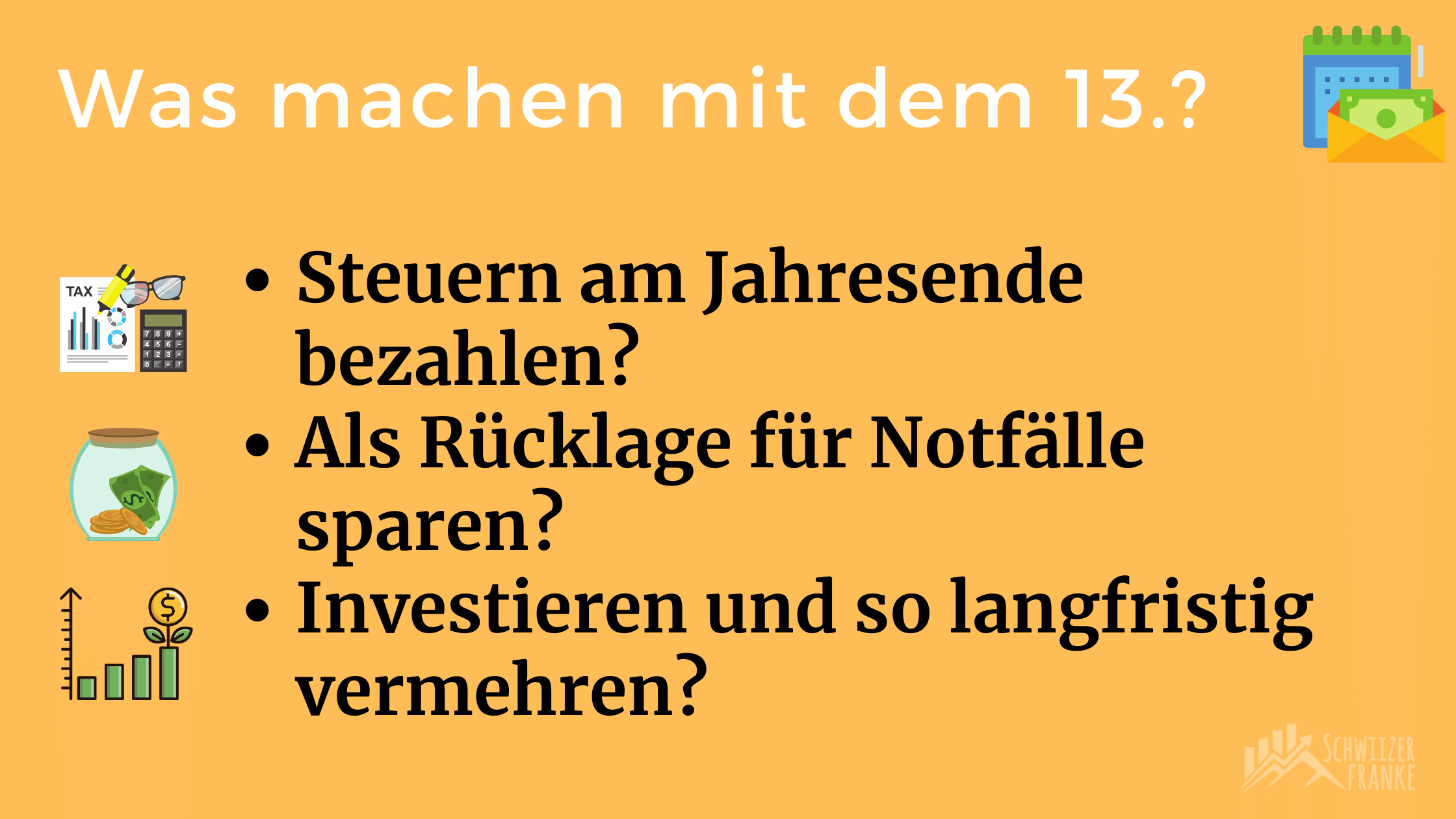
What should you use your 13th month’s salary for?
The 13th feels like a gift, but it’s actually pay that your employer has held back all year. Anyone who spends it on a whim in December often only realises this in January. So make a plan for it beforehand:
- Top up your savings: Three to six months’ worth of living expenses in your savings account. The Emergency Fund Calculator.
- Making a contribution to Pillar 3a: If you haven’t yet reached this year’s maximum allowance, you’ll save on tax. You can find the cheapest providers in the Pillar 3a comparison.
- Invest: With an ETF savings plan, you invest money for the long term. You can find a suitable provider in the Online broker comparison, Fundamentals in Investing money in Switzerland.
Conclusion
If you have agreed a thirteenth month’s salary in your employment contract, you are entitled to it, on a pro rata basis even if you join or leave the company during the year. It amounts to 1/12 of your total annual monthly wages, or 8.33 % if you are paid by the hour. The same social security contributions are deducted as from your normal wages. The 13th month’s pay is not a bonus, but an integral part of your annual salary and simply a different form of payment.
FAQ
How do I use the 13-month salary calculator?
Select whether you are paid a monthly, annual or hourly wage, and enter the gross amount. Use «Employed from» and «up to and including» to calculate the proportion for when you start or leave your job. The calculator will show you the 13th month’s pay (gross and net) and the deductions.
What deductions 13th monthly salary?
The same deductions apply as for the normal monthly salary: AHV/IV/EO, ALV, non-occupational accident insurance and, depending on the employer, daily sickness benefit. Contributions to the pension fund are often deducted in twelve instalments alongside the monthly salary, rather than as part of the 13th month’s pay.
Is the 13th month’s salary compulsory?
No. It is not required by law. You are only entitled to it if it is stipulated in your employment contract, the company regulations or the collective agreement.
How much is the 13th month’s salary?
If your pay remains the same throughout the year, it is exactly one month’s pay. Generally speaking: the total of your monthly pay for the year divided by 12.
When is the 13th month’s salary paid?
Usually in November or December. Some employers pay half in June and half in December, or spread the payment across all twelve monthly wages. If an employee leaves the company, it is payable with their final wage.
Am I entitled to my 13th month’s salary if my contract is terminated?
Yes, on a pro rata basis for the months during which you were employed. If your contract is terminated at the end of September, that works out as 9/12. This applies regardless of who gives notice.
Why is the net amount of the 13th month’s salary lower?
In addition to AHV, ALV and NBU, a higher rate of withholding tax applies because the 13th month’s salary is counted as part of the salary for the month in which it is paid. Under the standard taxation system, however, you do not pay the tax until you submit your tax return.
Is there a 13th month’s salary for hourly-paid workers as well?
Yes, usually as a supplement of 8.33 % on top of the hourly wage. If the contract states that it is included in the hourly wage, this amount represents 1/13 of your hourly wage.