



Shares tax Switzerland: What do you need to know?
Before we get into the tips, a brief overview. In Switzerland - unlike in Germany or the USA - there is no actual capital gains tax. However, the tax system makes a clear distinction between different types of tax that apply to your shares:
Capital gains (price gains): You buy a share for CHF 100 and sell it for CHF 150. As a private investor, the profit of CHF 50 is not capitalised. tax-free. This applies equally to Swiss and foreign shares.
Dividends and interest income: If a company distributes a dividend, this counts as a Taxable income. You must declare dividends in your tax return and pay tax on them at your personal tax rate.
Withholding tax (35%): 35% withholding tax is automatically deducted from Swiss dividends. You will therefore only receive 65%. The good news is that you will get the 35% back - if you declare everything correctly (more on this in tip 2).
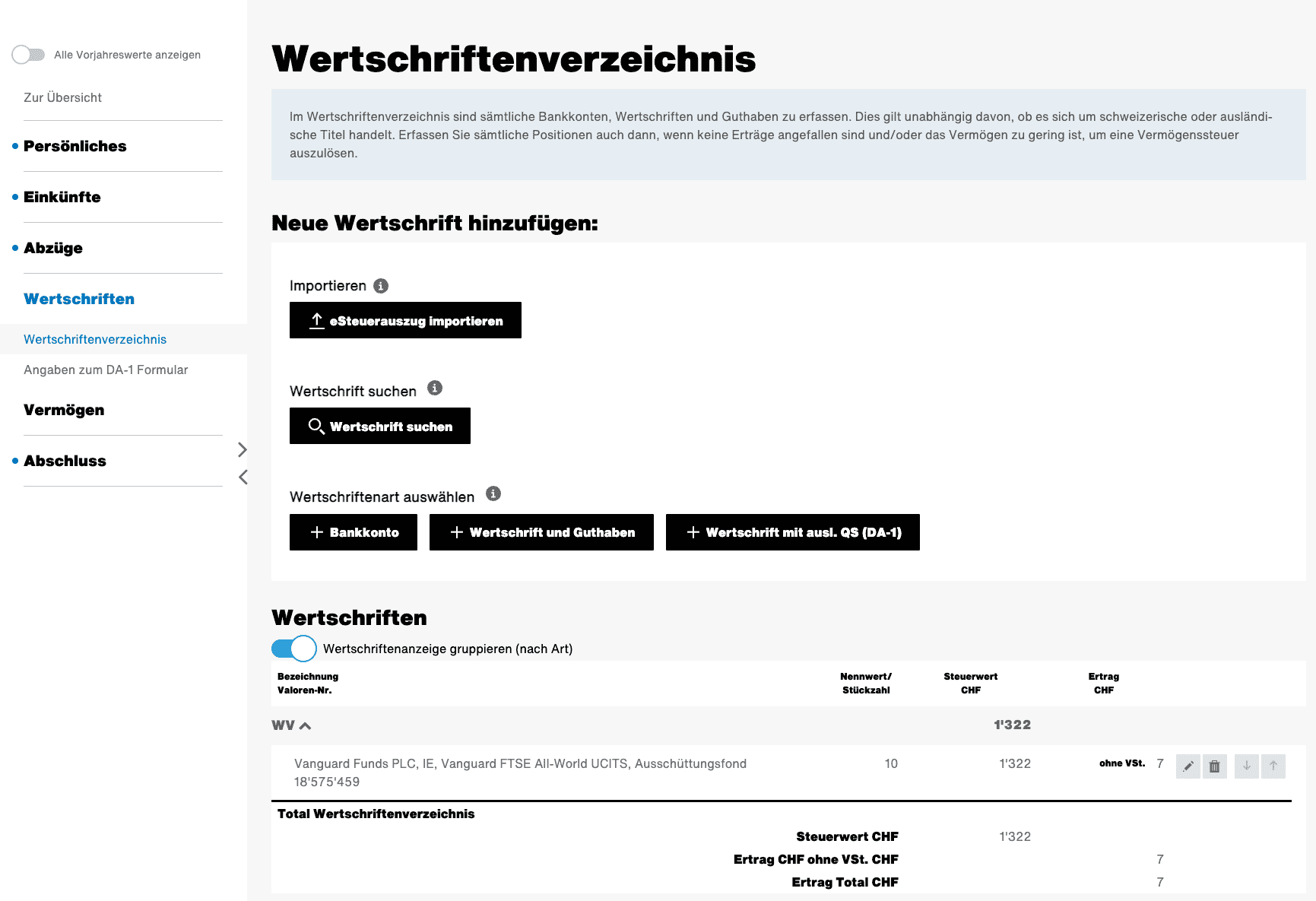
Property tax: Your share portfolio counts as taxable assets. It is valued at the market value on 31 December and entered in the securities register. The wealth tax varies from canton to canton.
Stamp duty: Federal stamp duty is payable on the purchase and sale of securities. This is deducted directly by your broker - you hardly notice it, but it appears on every statement.
You can find a comprehensive overview of all tax types in our Taxes Switzerland Guide. We have explained in detail how ETFs are treated for tax purposes - including the differences between accumulating and distributing funds - in the ETF Taxes Switzerland Guide prepared.




Good day,
What happens if I have realised capital gains on American shares such as Apple and Nvidia. For example, I made CHF 1000 + and also received a dividend totalling CHF 60.
Do I now have to declare this CHF 60 in my tax return or the capital gain? I invest according to time and need, so I am a normal private investor who is not employed but also has a profession.
Many thanks
Hello Ahmet,
You must include all shares in your tax return. Capital gains and distributions are recognised there anyway.
However, capital gains are not taxed for investors in Switzerland. Dividends are taxed.
Good day
What is the situation here with Bitcoin and co? If you sell bitcoins and therefore make a profit, are you immediately categorised as a trader? Also with shares etc? So how should you sell the cryptocurrency?
Lg
Hello Felix,
In Switzerland, this applies to securities in general, including Bitcoin.
A staggered sale over several years could make sense if there is too much volume.
I am planning to move to Zurich for work, but have two problems when It comes to my retirement plan. First I would plan to save 30,000-40,000 CHF for the next 6-7 years, as I am single and have little expenses accompanied by a good job. If invested in a stock portfolio of maybe 8-15 stocks and held them for an average of 3 years at a time would I be classified as a professional investor? I would plan to maintain a leverage ratio of 25% (i.e. for every CHF of equity I would have .33 CHF of debt this would be (1.33-1)/1.33=25%). Secondly, I worry that after 15-20 years I could have a large amount saved and if I suspected a market crash I might sell all of my investments in one year to protect against a crash to buy them back again over the next year or two. This could potentially lead to accumulated gains far greater than my income although the average holding period would potentially be 5-15 years at this stage. Could either of these two events/strategies have me classified as a professional investor?
Hi Isaac,
as I am not a tax expert, I cant guarantee you anything and will not advise on that. In my opinion your case is a normal savings/investing scenario, so there is no need to be worried. Exception: the leveraging aspect looks a bit aggresive/professional.
Hello
Thanks a lot for your great info! How are share price gains on foreign shares taxed? So Apple, Microsoft, Tesla etc.?
My understanding of the article is that it only concerns Swiss shares!
Thanks for the great info on your website!
Best regards
Hello Raphael
It doesn't matter. As long as you are taxable here, capital gains are not taxed. In the case of distributions, however, the situation is different.
Love!
I have just sold a bunch of RSU from my company that I held on for a few years.
This transaction alone was in the six figure range and definitely above my annual income.
Now I would like to invest this capital on ETF shares for long-term gains (something like 5 to 10 years).
Do you think this could cause the tax office to flag me as a professional investor?
Hello zämä
Thank you for the good overview and tips.
However, I'm not quite sure what the situation is with forex and CFD trading - i.e. mainly day trading. When I close the positions, I don't have any securities that I would have to declare as capital at the end of the year in my tax return. Of course, it is common practice in day trading to open a few (small) positions and close them again after a short time. Consequently, the volume of trades would also be large, even if the amount is often small. And as far as I know, there is no 'capital gains' item on the tax return that I can proactively declare. How are taxes (-authority) actually handled there?
Of course, it is noticeable when you have much more assets at the end of the year than would be possible with your main income minus the normal costs. Nevertheless, it would be interesting if someone had an idea.
Thank you and greetings
Anita
Hello Anita
Day trading falls precisely into this category. Such a case quickly becomes critical from a tax point of view and is closely examined by the tax office.
The bad thing is that once you are classified as a professional trader, this applies for life and tax-free share gains will no longer be possible.
However, the tax office will not immediately put you in this category, but (hopefully) only in absolutely appropriate cases.
Quick question - I have a very long-term strategy with only a few companies. I would like to liquidate the portfolio in a few years and expect a return in the higher six-figure range. This would of course massively exceed my annual income. In this case, do I run the risk of being taxed accordingly?
Hello Urs
Since you invested for the long term, it should not be a problem. After all, it wasn't trading and it doesn't happen every year. So I personally wouldn't worry about it. If in doubt, talk to a tax advisor.
Oh and: Congratulations 🙂
Hello, I have two different stock portfolios that I would like to put together for reasons of diversification. specifically, I have a portfolio with 80,000 euros and 37,000 euros. In addition, there are other investments of about 20,000 euros. I would like to dissolve the depot of 37,000 euros and put the money in the large depot. I hold most of the shares for more than 6 months.
PS Euro figures are due to the fact that I have the deposits in Germany.
Hello Toni, do you have a specific question in this regard? As a rule, it is easy to transfer a securities account. If you want to sell securities and you comply with the above points, you do not have to worry about taxes.
Exactly. Only when you make an annual profit of at least CHF 50,000 through investment income or capital gains do you need to look into this topic again.
What is the understanding of the holding period with respect to partial sales?
Example: I buy 5 shares of company A on 01.02. and on 01.03. another 5 shares of this company. How many shares of company A may I sell on 01.08. so that this point is fulfilled? None, 5 or 10?
Hi Jakob, pure gut feeling/judgement: In theory, every trade counts, but people probably pay more attention to the overall picture than to the exact details. One "small trade" will not immediately make you look like a professional trader. If you trade all the time and earn the majority of your income with it, it will certainly look different.
Hello
I have a tax question maybe you can help me:)
What does it look like if I invest on a crowdfunding platform, for example? For example, I invest CHF 10,000 in "Product X" and after six months I get CHF 12,000 back from this investment. How is this taxed in Switzerland?
Hello Sazu
here it depends very much on how and where you have invested. A Swiss crowdlending platform? Then take a look here: https://www.mme.ch/de/magazin/crowdfunding_aus_steuerlicher_sicht/
If it's a capital gain - you don't have to pay tax on anything!
I intend to quit my job and live off dividend income. I can easily comply with all other rules. Does dividend income also count towards the 50% rule, so does that automatically make me a professional trader? Or does only capital gains really count there?
Hello Sven
here a discussion with a specialized tax advisor would certainly be useful. I believe not that this automatically classifies you as a professional trader. However, this in combination with frequent trading etc. can of course bring the attention of the authorities. Also, a tax advisor may find a way how you can optimize your tax contributions, as these should not be low for you.
Love and congrats on your plan!
How is for an Austrian this
situation to see.will after österr.
tax net.
I am interested in the switzerland a
open an account and move stock exchange work to switzerland.
Mfg.f. m.n
Hello Friedrich
I am not familiar with taxes in Austria. But during a short Google research I came across this:
Avoid double taxation - this is how it works
"In Austria, investors can have the foreign withholding tax credited against up to 15 per cent of the investment income. You then only pay the difference up to the withholding tax rate to the Austrian tax authorities, i.e. 10 per cent (for account and savings account interest) or 12.5 per cent (for all other investment income). As a rule, your own broker will do this automatically if they are based in Austria." Here is the link to the source: https://www.testsieger.at/wertpapiere/steuer/
The best thing to do is to do some more research on the subject yourself or seek out a tax advisor who specializes in this area.