



MSCI World vs. FTSE All-World:
Which global ETF is right for you?
MSCI World or FTSE All-World? There’s hardly any other question about ETFs that’s asked more often.
We have produced this article in collaboration with Invesco. This has not affected our editorial judgement or selection.
If you’re looking for a global equity ETF, you’ll soon find yourself faced with this very choice. Both are among the most popular global indices at all. Nevertheless, there is one important difference: the The MSCI World Index comprises only developed countries, the FTSE All-World plus emerging markets. Which option is best for you depends less on past returns than on how straightforward you want to make building up your investment portfolio.
| You want a global equity ETF as a core component | FTSE All-World |
| You already own an MSCI World ETF | Hold MSCI World |
| You want to weight emerging markets yourself | MSCI World plus Emerging Markets ETF |
| You’re unsure | Both are sound solutions |
The The key difference lies in the emerging economies: The MSCI World comprises only shares from developed markets, whilst the FTSE All-World also includes shares from emerging markets. For many new investors, the FTSE All-World is therefore the simpler core investment. However, anyone who already holds an MSCI World ETF does not need to switch simply for that reason.
Table of contents
MSCI World vs. FTSE All-World: the difference
The main difference can be summed up in a single sentence: The The MSCI World Index comprises only companies from developed countries, the FTSE All-World, plus companies from emerging markets.
In short: The FTSE All-World is suitable for many beginners as A simple, single-ETF solution for the global equity allocation, whereas with the MSCI World Index, the You decide the weighting of emerging markets, via a separate item.
| Feature | MSCI World | FTSE All-World |
| Countries | 23 industrialised countries | Industrialised and emerging economies |
| Company | around 1,300 | around 4,200 |
| Company sizes | Large and medium-sized companies | Large and medium-sized companies |
| US share | around 72% | around 62% |
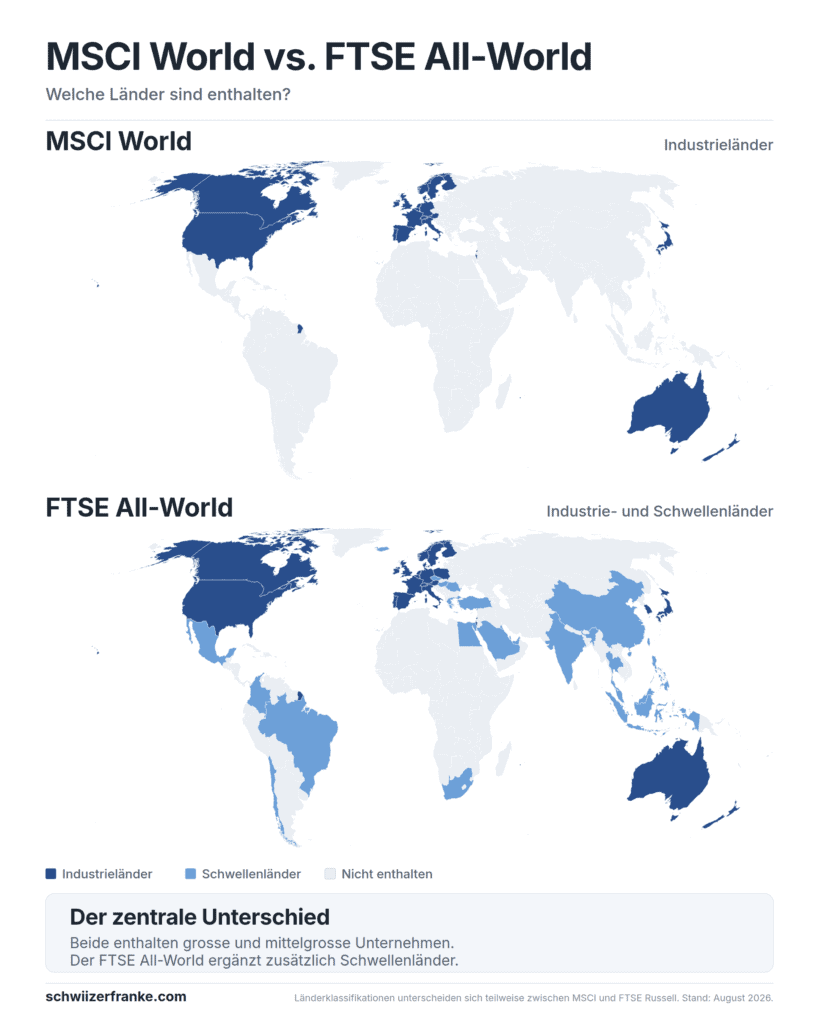
Both indices are continuously reviewed by their index providers and adjusted in line with market trends. As an investor, you do not need to worry about this yourself.
Does the FTSE All-World Index also include small-cap companies? Small-cap shares are shares in smaller listed companies. It is often assumed that the FTSE All-World index includes them as well. This is not the case. Both indices include large and medium-sized companies. The additional constituents are primarily from emerging markets.
Why, then, is the US share still smaller? If emerging markets account for around 10 to 12 per cent of the index, the proportion of US shares falls accordingly. It is therefore not the case that the FTSE All-World deliberately holds fewer US shares.
A brief note on the MSCI ACWI: The MSCI ACWI also comprises developed and emerging markets and is therefore much more similar to the FTSE All-World than to the MSCI World.
The key question is therefore not which index includes more companies, but whether emerging markets are at all a good fit for your strategy.
Top recommendations for 2026
Your key to success! Discover our top recommendations from real testimonials.





Do you even need emerging markets?
Emerging markets account for around 10 to 12 per cent of global market capitalisation. A global ETF that excludes emerging markets therefore leaves out a portion of the global equity market. This is precisely where they differ: the FTSE All-World Index includes both developed and emerging markets, whilst the MSCI World Index includes only developed markets.
The case for emerging markets:
- They form part of the global investable portfolio. Anyone who excludes them entirely is deliberately overweighting developed countries.
- They do not always follow the same pattern of development as industrialised countries and can therefore increase diversification.
Arguments against this:
- Higher political risks, and in some cases a weaker rule of law
- Greater volatility, with some countries experiencing significant setbacks
- Higher rates of economic growth do not automatically translate into higher returns on shares.
The real question, therefore, is not whether emerging markets are good or bad, but whether you want them to be an integral part of your global portfolio.
This leads to two possible courses of action:
FTSE All-World → Emerging markets are automatically included; no separate holding is required.
MSCI World → Manage emerging markets deliberately as a separate category, or avoid them altogether.
For most investors, what ultimately matters less is whether emerging markets are included, but rather whether the chosen approach is easy to stick to.
For most people, the election is less important than they thought
Many investors spend hours comparing the MSCI World and the FTSE All-World. Yet this decision is usually less important for long-term investment success than it appears at first glance.
Whether one index outperforms another slightly over many years often matters less than the decisions investors make themselves. Those who sell following a stock market fall or repeatedly interrupt their regular savings contributions usually have a significantly greater impact on their returns.
That is why, in my content, I place far greater emphasis on a a simple system that can be sustained in the long term rather than the final differences between two very similar global indices. In my view, it is precisely this decision that will make the bigger difference in the long term.
A look at recent years shows how these differences have affected returns over time.
How have the indices performed historically?
The differences in composition also affect the return.
| Period | MSCI World | FTSE All-World |
| 5 years per annum. | 11,2% | 10,8% |
| 10 years per annum. | 12,7% | 12,3% |
| 20 years per annum. | 8,7% | 8,5% |
Over five, ten and twenty years, the MSCI World index outperformed. It was more heavily weighted towards the US during these periods. At the same time, US equities performed particularly well over much of this time.
However, this lead is not set in stone. Over shorter periods, the FTSE All-World may well be ahead. Which of the two is ahead depends heavily on the time period under consideration.
That is precisely why past performance is not a good criterion for choosing between the two indices. What really matters is which markets you want your portfolio to cover.
Which index is right for you?
Four typical situations emerge from the considerations set out so far.
New here?
→ FTSE All-World.
For most investors, it is the easier way to get started, as emerging markets are already included.
Have you already invested?
→ Hold the MSCI World.
The returns were very similar over the periods under review. It is not possible to deduce from this which index will come out on top in future. In most cases, switching does not offer any significant advantage.
Greater control over emerging markets?
→ MSCI World plus Emerging Markets ETF.
This allows you to set the proportion of emerging markets yourself.
Deliberately excluding emerging markets?
→ MSCI World.
Anyone who, out of principle, does not wish to hold emerging markets in their portfolio can use the MSCI World index to achieve a broadly diversified exposure across 23 developed countries.
You now know which index suits your strategy. The next question is: Which ETF should you choose based on that?
ETFs tracking the MSCI World Index
There are numerous ETFs tracking the MSCI World Index. By way of illustration, we compare three established, reinvesting funds that differ in terms of costs, tracking method and fund size.
| ETF | TER | Replication | ISIN |
| Invesco MSCI World UCITS ETF | 0,05% | Synthetic (swap) | IE00B60SX394 |
| UBS Core MSCI World | 0,06% | Physical | IE00BD4TXV59 |
| iShares Core MSCI World | 0,20% | Physical | IE00B4L5Y983 |
The Invesco MSCI World UCITS ETF With a current TER of 0.05 per cent, it is one of the lowest-cost products in its category. It tracks the index synthetically via a swap. This means that the index performance is not achieved by directly purchasing all the shares, but through swap agreements with counterparties. In addition to low ongoing costs, this structure may also offer tax advantages, particularly with US shares, as withholding tax on dividends may, under certain circumstances, be handled more efficiently. This is merely a potential financial benefit in terms of the swap’s performance before fees are deducted. However, this benefit is not guaranteed. At the same time, the swap structure gives rise to counterparty risk. However, this risk can be mitigated through regulatory requirements, collateral and additional measures. These include, amongst other things, working with multiple swap counterparties and the frequent, sometimes daily, resetting of swap positions. This reduces the risk, but does not eliminate it entirely. Further risks apply. Please refer to the relevant legal documents.
This section was produced in collaboration with Invesco.
The iShares Core MSCI World and the UBS Core MSCI World Both are physically replicated and comparable in this respect. With assets well in excess of 100 billion US dollars, the iShares is by far the largest of the three ETFs; the UBS, with a TER of 0.06 per cent, is only marginally more expensive than the Invesco.
As all the ETFs mentioned track the same index, the main factors to consider in practice are costs, the tracking method, the fund’s size and personal preferences.
Our financial tips for 2026
"Intelligent people learn from the mistakes of others".
We have compiled our top selection for you from all our tests and experience reports:




ETFs tracking the FTSE All-World
There are now also several ETFs tracking the FTSE All-World index. By way of illustration, we compare the key products, which differ in terms of costs, fund age and fund size.
| ETF | TER | Replication | ISIN |
| Xtrackers FTSE All-World | 0,07% | Physical | IE000L6ZMMC4 |
| Vanguard FTSE All-World | 0,14% | Physical | IE00BK5BQT80 |
| Invesco FTSE All-World UCITS ETF | 0,15% | Physical | IE000716YHJ7 |
| Invesco FTSE All-World UCITS ETF (CHF-Hedged) | 0,20% | Physical | IE000SHR0UX9 |
The Vanguard FTSE All-World is the established classic. The accumulation share class was launched in 2019 and manages around 53 billion US dollars. The ongoing charges have stood at 0.14 per cent since July 2026.
The Invesco FTSE All-World UCITS ETF stands at 0.15 per cent, just above that figure. The fund was established in 2023 and now manages assets totalling over 5 billion US dollars, which is equivalent to around 4 billion Swiss francs.
The Xtrackers FTSE All-World At 0.07 per cent, it is currently the lowest-cost ETF tracking this index. However, it was not launched until 2026 and therefore has significantly less track record and fund assets than Vanguard and Invesco.
Invesco is also the only provider to offer a CHF-hedged version of its FTSE All-World ETF. It is aimed at investors who wish to deliberately hedge against exchange rate fluctuations against the Swiss franc. The TER is 0.20 per cent instead of 0.15 per cent.
What Swiss investors should also bear in mind
Four practical tips for putting this into practice.
Check the availability of savings plans. The lowest TER is of little use if the ETF isn’t available through your broker or incurs high purchase fees. Before choosing an ETF, always check whether your broker offers that specific ETF as part of a savings plan. We compare the leading providers in our Online Broker Comparison: Switzerland.
Trading currency is not the same as currency hedging. If you buy an ETF on the SIX in Swiss francs, this can help you avoid additional currency conversion costs at the time of purchase. However, this does not alter the currency risk associated with the underlying shares. This risk remains because the companies continue to be quoted in US dollars, euros, yen and other currencies. A CHF-hedged ETF aims to hedge against a large proportion of these currency fluctuations. The hedge may be incomplete and incurs ongoing costs.
Check the tax values. For established UCITS ETFs, the relevant tax values can usually be found in the FTA’s ICTax price list. This simplifies the Swiss tax return.
A single global ETF is a solid building block, but it is not automatically a complete investment strategy for a Swiss investor. We have discussed in detail in a separate article why adding a Swiss component to your portfolio can be a good idea: Why a single ‘All-World’ ETF is not a ready-made strategy for Swiss investors.
Conclusion
MSCI World or FTSE All-World? The differences are smaller than many people realise. Both global indices are suitable as the core of a long-term portfolio. For most investors, therefore, it is less important which of the two they choose than that they opt for a simple solution and stick with it over the long term.
Ultimately, the best global ETF isn’t the one with the lowest TER to the last decimal place, but the one you hold consistently for decades, even during difficult market phases.
FAQ
Should I switch from the MSCI World to the FTSE All-World?
In most cases, switching does not offer any significant advantage. Returns were very similar over the periods under review, and it is not possible to predict which index will outperform in the future. Anyone who already holds an MSCI World ETF can generally keep it. Anyone wishing to deliberately add exposure to emerging markets can use a separate emerging markets ETF for this purpose.
Is the FTSE All-World ETF sufficient on its own?
A single FTSE All-World ETF may be sufficient as a global equity component. However, a comprehensive investment strategy involves more than that: your risk tolerance, a liquidity reserve, pension provision across the three pillars, and, depending on your circumstances, other asset classes.
What is the difference between the FTSE All-World and the MSCI ACWI?
Both indices comprise large and medium-sized companies from developed and emerging markets. They differ primarily in terms of country classification, the selection of companies and their weightings. The FTSE All-World contains more individual stocks than the MSCI ACWI. Nevertheless, their underlying investment strategies are very similar.
Does the trading currency of an ETF matter?
The trading currency affects any potential exchange costs when buying and selling. However, it does not alter the currency risk associated with the underlying shares. A global ETF traded in CHF is therefore not automatically currency-hedged.
Is a CHF-hedged global ETF a sensible choice for Swiss investors?
A CHF-hedged ETF aims to reduce a large proportion of the fluctuations in foreign currencies against the Swiss franc. Whilst this can dampen fluctuations in CHF terms, it incurs additional costs and does not always work perfectly. Whether hedging is worthwhile therefore depends less on a forecast return than on how important it is to you to have more stable values in Swiss francs in the short term.
The next step: finding the right broker
Whether it’s the MSCI World or the FTSE All-World: buying fees, switching costs and savings plan options can vary significantly from one broker to another.
Go to the online broker comparison for Switzerland →Legal notices from Invesco
Key risks
The value of investments and the returns they generate are subject to fluctuations. This may be partly due to changes in exchange rates. It is possible that investors may not recover the full amount invested when they redeem their units.
Full details of the risks can be found in the sales documentation.
Invesco MSCI World UCITS ETF: The Fund’s ability to replicate the performance of the benchmark depends on counterparties consistently achieving the benchmark’s performance in accordance with the swap agreements and is also influenced by the spread between the pricing of swaps and the pricing of the benchmark. The insolvency of institutions that provide services such as the safekeeping of assets, or that act as counterparties to derivatives or other instruments, may result in a financial loss for the fund. The value of the shares may be affected by certain factors, such as the issuer’s circumstances or economic and market conditions. This may lead to fluctuations in value. The Fund may acquire securities that are not included in the benchmark index and may enter into swap agreements to exchange the performance of these securities for the performance of the benchmark index. The Fund’s performance may be affected by fluctuations in exchange rates between the Fund’s base currency and the currencies in which the Fund holds exposure. The Fund invests in a specific geographical region, which may result in greater fluctuations in the Fund’s value than would be the case for a fund with a broader investment mandate.
Invesco FTSE All-World UCITS ETF: The fund may be exposed to the risk that the borrower fails to fulfil its obligation to return the securities at the end of the loan period, and that it is unable to sell the collateral provided to it in the event of the borrower’s default. The value of the shares may be affected by certain factors, such as the issuer’s circumstances or economic and market conditions. This may lead to fluctuations in value. The fund’s performance may be adversely affected by fluctuations in exchange rates between the fund’s base currency and the currencies in which the fund holds exposure. The Fund may use Stock Connect to gain access to China A-shares traded on the Chinese mainland. This may give rise to additional liquidity and operational risks, including settlement and default risks, regulatory risks and the risk of a system failure.
Important information
This marketing information is provided for discussion purposes only and is intended solely for investors in Switzerland. Investors should read the sales documents before making a final investment decision.
This is marketing material and does not constitute investment advice. It is not intended as a recommendation to buy or sell any particular asset class, security or strategy. Regulatory requirements mandating the impartiality of investment or investment strategy recommendations therefore do not apply, nor does the trading ban prior to their publication.
These views and opinions are based on current market conditions and are subject to change at any time.
Published by Invesco Asset Management (Switzerland) AG, Talacker 34, 8001 Zurich, Switzerland. The representative and paying agent in Switzerland is BNP PARIBAS, Paris, Zurich Branch, Selnaustrasse 16, 8002 Zurich. The prospectus, the key information document, the financial reports and the company’s articles of association may be obtained free of charge from the representative. The ETFs are domiciled in Ireland. EMEA 5868961
Invesco FTSE All-World UCITS ETF: The Invesco FTSE All-World UCITS ETF (the "Fund") was developed exclusively by Invesco. The Fund is in no way affiliated with, or sponsored, endorsed, sold or promoted by, the London Stock Exchange Group plc and its group companies (collectively, the "LSE Group"). FTSE Russell is a trading name of certain companies within the LSE Group. All rights to the FTSE All-World Index (the "Index") are held by the relevant LSE Group company that owns the Index. FTSE® and ICB® are trade marks of the relevant LSE Group company and are used under licence by all other LSE Group companies. The Index is calculated by or on behalf of FTSE International Limited or its subsidiary, agent or partner. The LSE Group accepts no liability whatsoever to any person arising from (a) the use of the Index, reliance on the Index or any error in the Index, or (b) an investment in the Fund or its operation. The LSE Group makes no claims, predictions, guarantees or representations regarding the results to be achieved by the Fund or the suitability of the Index for the purpose for which it is used by Invesco.
Invesco MSCI World UCITS ETF: The Fund is not distributed, promoted or endorsed by MSCI Inc. ("MSCI"). MSCI accepts no liability for the Fund or for the indices on which the Fund is based. The prospectus contains a detailed description of the liability arrangements between MSCI and Invesco or the funds affiliated with Invesco.

Wow, thanks so much, Eric. That’s exactly the line of thinking I’ve had in mind for ages. You’ve hit the nail on the head, and to be honest, I hadn’t really fully grasped the differences between return and risk.
That was a real eye-opener 🙏🏼