 Skip to content
The environmental movement is catching the eye of more and more people, including investors. Inyova (formerly represented under the name Yova) impact investing has set itself the task of making sustainable investing easy for us.
In the following, you can find out how the costs and returns behave, what criticism and what praise should be given Inyova experience report!

The Swiss platform Inyova is a regulated investment provider for impact investing Switzerland. Inyova offers impact investing for investors from Switzerland.
Focus on sustainabilitybut the return on investment should not be lost sight of. To keep the risk within limits, the investments are broadly diversified. The Individual shares and bonds are analysed closely in terms of their sustainability. Fees are shown transparently and the strategy is very customizable.
Our Inyova experience report goes into detail, but we can already pass on a positive impression in advance! Inyova is constantly evolving - in addition to Invest and the Pillar 3a was also realised in 2024 Inyova Grow as a solution for sustainable alternative investments.

You take a algorithm, which you can use with the ETH Zurich develops, gives him the The goal of a sustainable investment strategy to make and ready is Inyova. No, of course it's not that simple. But at the heart of Inyova is an algorithm that can make sustainable investments for you according to your criteria.
You can determine the focus of the investments. For example, you can also use Inyova Yellow invests specifically in companies that gender equality promote.
Your investment will be broadly spread over many companies in order to Risk to minimise the risk. Government bonds are also included, for example to smooth out fluctuations.
In general, Inyova Impact Investing could therefore be described as a sustainable Swiss Roboadvisor classify. Your investments will be paperless which also corresponds to the aspect of sustainability.
By the way, Inyova stands for: Invest in your values.
"Intelligent people learn from the mistakes of others".
We have compiled our top selection for you from all our tests and experience reports:


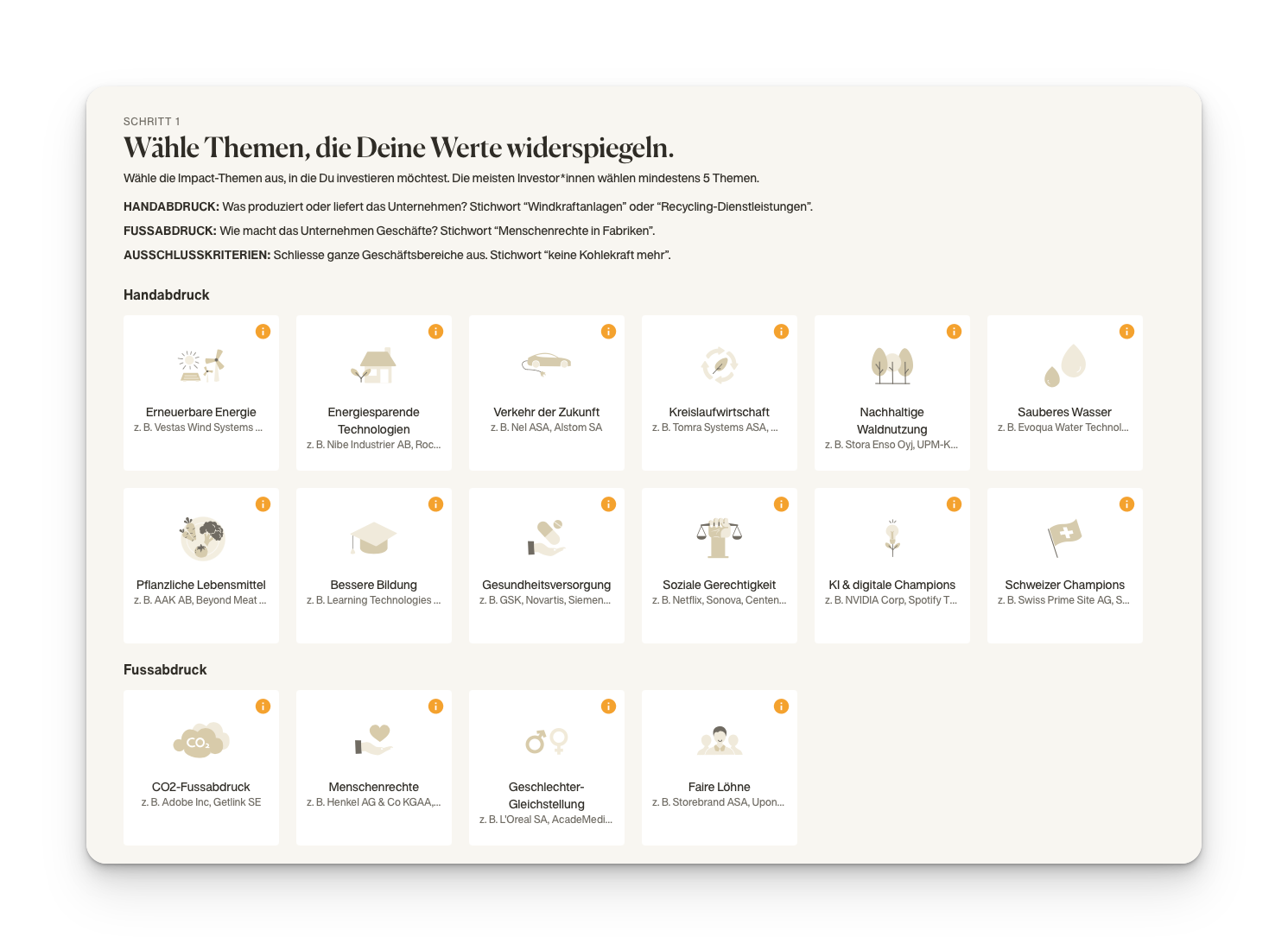
Impact topicsThe investment opportunities available for selection are analysed in advance for "handprint" and "footprint". You decide where you want to invest with Inyova and can even define exclusion criteria.
Direct investments: Your investments are written in your name and belong to you. At Inyova, you get your own account, so to speak, to which your investments are written.
Swiss platform: Supervised by the Swiss FINMA, Inyova Impact Investing meets all regulatory standards
Flexible: Your money is very liquid, so it is easily accessible. If you suddenly need the invested capital, you can access it within a week.
Low minimum deposit: From CHF 2'000 minimum deposit you can invest and gain your first Inyova experience.
Automated risk management: To ensure that your money is safely invested, Inyova Impact Investing always invests it in a broadly diversified manner.
Transparency: The fees of Inyova are clearly arranged.
Inyova Grow: The Inyova Grow solution, which was launched in 2024, enables investments in sustainable projects via bonds with fixed interest rates of up to 8%. The offer has evolved, but harbours particular risks (illiquidity, issuer risk). Find out more in our Inyova Grow Review.
Digitalisation brings Transparency into formerly opaque areas such as the financial market.
In the course of our Inyova experience report, we have therefore naturally also Fees and have praise, but also criticism to note.
First the good news: Inyova Fees and costs are Completely transparent and easy to understand. You can use the fee calculator to enter how much money you want to invest sustainably and the monthly Inyova fees are displayed directly.
Let's say you want to get some experience with Inyova first and start with a small amount. You must invest at least CHF 2,000There is no upper limit.
For investments up to CHF 50,000, fees of 1.2% per year will be charged. For a sustainable investment of CHF 5,000, this corresponds to an Inyova fee of CHF 5 per month. In order to increase transparency, here is a comparison with a sustainable ETF and an Inyova ETF. Selma Finance.
In fairness, however, it must be said that Selma also automatically invests for you, and a Swiss service provider as Inyova is. However, Selma does not prioritise sustainability. Although it has recently become possible to switch all investments at Selma to sustainable investing at the touch of a button, the Quality of the assessment of the sustainability criteria not comparable.

Since the end of 2021, customers have also been able to save or invest in 3a, which naturally improves the overall experience in the Inyova Review.
This makes Inyova one of the most consistent providers of sustainable 3a pension provision in Switzerland. Although sustainability in pillar 3a is now also possible with other providers, it is hardly implemented as meticulously as with Inyova.
The Inyova 3a fees are 0.8% per year (All-in incl. transactions and currency exchange). In the event of an early withdrawal (e.g. home ownership or departure from Switzerland), additional fees may be charged by the pension partner Liberty.
Revenue and costs go hand in hand, this is clear. The Inyova cost example above has shown that Inyova's fees are not entirely small. The Inyova yield However, it is not so easy to put your finger on it. Depending on the strategy you choose, your return or performance will be very individual.
If you research and check other reviews for Inyova, you will hear again and againthat sustainable investments generally generate poorer returns. This is not necessarily the case, as "sustainability" can also remove environmental and other risks from the portfolio, for example, and thus potentially increase returns.
However, due to the sometimes increased bureaucratic effort and other necessary detours for the "Sustainability seal of approvalcosts are incurred, which reduce the return.
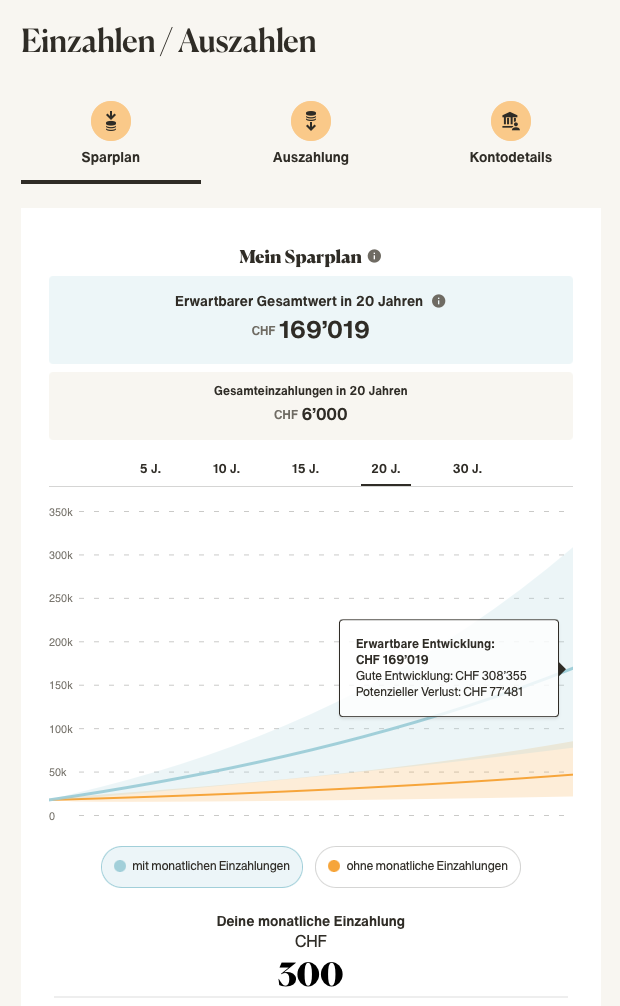
Return on sustainable ETFs: impact investing can bring good returns, but returns are not the sole focus. However, if you want to have a positive impact on your investments, this should not be a problem. The sustainable ETF listed above, for example (ISIN DE000A0F5UG3), has generated almost 60% Yield earned. You can do this here in the chart for yourself. This good performance is certainly not always feasible, but it shows that sustainable investments can also be profitable, including the coronavirus crash.
For many, sustainable investing is certainly in tune with the times. Forest fires, severe thunderstorms and heated discussions about electromobility are just a few examples. (Let's leave Trump aside for a moment). Inyova Impact Investing has therefore positioned itself skilfully in terms of timing and is taking some of the effort out of investing for the Swiss. sustainable investing as of.
Negative about the Inyova reviews? The Fees stand out in the Inyova test, because they are not quite small and should hopefully fall in the long term. This happens with many providers as the number of customers or assets increases. However, you should bear in mind that the research work etc. required by Inyova to ensure sustainability is very costly and therefore has its price. Other digital asset managers are cheaper, but do not specialise in sustainability.
The Digital solution works perfectly and we could not see any technical problems or hurdles in the user interface in our tests. Customer service is very friendly and easy to reach and therefore receives a very good Inyova rating.
In short, for anyone who values sustainable investing, Inyova is one of the most exciting options in Switzerland - with the aforementioned restrictions in terms of fees.
Tip: I like to use the Inyova couponto save on fees!
Let us know in the comments what you think of Inyova and sustainable investing in general!
"Intelligent people learn from the mistakes of others".
We have compiled our top selection for you from all our tests and experience reports:
We use cookies to ensure that our free calculators and comparisons work perfectly. Statistics cookies also help us to improve the site for you. You decide - and can change them at any time.
Hey everyone, thanks Eric for the report. I find the possibility to invest sustainably top!
Therefore, whoever wants can use my referral code to benefit.
Best regards Jürg
I signed up through your link and start with 100 euros. I do not want to invest too much in the beginning, because I'm a bit skeptical, but the voucher I take with pleasure.
Super! Start small, test and adapt - always a good approach with new providers 🙂
Depuis novembre 2021 j'ai déjà perdu 1600 CHF sur 20'000 CHF avec que des pertes de jour en jour. Je regrette donc amèrement d'avoir placé cet argent sur InYova dont les performances sont misérables.
Reste plus qu'à tout retirer avant qu'il ne reste plus rien de mes 20'000 CHF
Hi Anjoco, if you invest in stocks and other volatile assets, you have to expect fluctuations. Therefore, we always recommend that you only invest money that you will not need for the next 7-10 years. This way you don't have to sell at a loss in times like now, but can make profits in the long run.
The sum you have indicated corresponds to about 8% minus. Since the Ukraine crisis is currently causing the stock markets to fluctuate, the 8% is not surprising. I do not give an investment recommendation. Hopefully, calmness and a long-term strategy will help you to make the right decisions.
What do I do in times like now? Either keep my feet still and wait and see. Or buy more. But I don't sell, because I have a positive long-term expectation.
No investment advice.
Depuis mon message de février les pertes ont continué d'augmenter et j'ai été contraint de retirer 16'000 CHF pour éviter des pertes encore plus lourdes, car plus le montant d'investissement est grand, plus one peut gagner en théorie, mais plus one perd en pratique dans le contexte actuel.
Personnellement je ne crois pas à un investissement rentable sur le long terme de 5 à 10 ans car l'effet yoyo persiste sur la durée et le gain n'est donc pas progressif.
Hello Together
Super contribution, I am convinced of impact investing
Thanks for your exciting article. I think the fees are quite okay considering that your money is invested sustainably for it. Hey and also, you can save the fees for 6 months if someone starts investing with your code at Yova. Also the new investor pays no fees for 6 months. Timo
With my code you get 6 months without fees. In addition, Inyova will plant two trees for us. 🌱
Find this a great way to invest even as a beginner. I am very new here and also find it great that the fees of 6 months are given to you when someone starts investing with your code at Inyova.
Also the new investor pays no fees for 6 months. It is worth it for both of us 😉
I have been with Yova for 5 months and am super satisfied. I find the fees ok, my main argument is the sustainability and that I can choose the areas in which I want to invest. But I also haven't done a comparison with other providers. After all, you can save the fees for 6 months if you have someone start investing with your code at Yova. Also the new investor pays no fees for 6 months. So anyone who wants to try Yova fee free for 6 months, feel free to do so with my code: 02e82. Thanks to Eric for letting me publish the code here. Anne
Sustainable investing is important and should cost something. What I cannot understand, however, is why Yova and Selma are working with a partner that can hardly fulfil the claim of "impact investing". The customer funds are placed with Saxo Bank, which belongs to 51% the Chinese car manufacturer Geely (MSCI ESG rating = BBB, i.e. unsatisfactory). That's a shame, because sustainability must also be exemplified. Then Descartes Finance or TrueWealth.
Hello, Elena,
I absolutely agree with you - sustainability can cost something. I am convinced that it will pay off in the long term.
By the way, Geely as an automaker has a better ESG risk score than Tesla. This is despite the fact that Tesla has greatly reduced its use of cobalt, for example, and keeps a close eye on this aspect with its impact reporting.
I think what's important is that the providers somewhere begin and implement. But I understand your point if you also care about partners of a company in the screening.
I can confirm all what is above. Yova is super simple and really let you choose a nice panel of preferences and finally each company. You don't need any foreknowledge, and you don't have anything to keep track of. Transferring more money is also very simple. Everything is very transparent, easy to follow on your mobile phone. Yes it may appear expensive but so far the performance justifies it. At the end, my interest is not to make money but rather to have my money working for a better world.
I can just advise the platform. It's working perfectly and the stock picks are in line with the sustainability expectation I had.
Been with Yova for about a month. So far I'm very satisfied. I have also chatted with a colleague once, was super friendly.
The comparison with Selma is a bit misleading, Yova invests directly and not via ETFs. In addition, each company is analysed much more closely and only those shares are bought that match the personal criteria.
Hi, Fabio,
Correct, a direct comparison is difficult. As Roman has already mentioned below, investing with Yova may harbour the risk of strong fluctuations - precisely because the investments are adapted to personal criteria, as you say.
Diversification is a topic in itself. But sustainable investing is a good thing and if you are happy with Yova, I am all the more pleased! 🙂 Best regards!
Hello Nico W. Hello Eric
I am from FREYA Savings, another Pillar 3a provider that offers exclusively responsible investments. I would therefore like to respond briefly to your questions / information:
1) Nico: Why is YOVA relatively expensive (1.2% TER)? My answer: By investing directly in individual securities, YOVA incurs relatively high transaction costs - with monthly re-balancing this becomes very expensive. On the other hand, YOVA offers a higher degree of individualisation. Another negative aspect is that the YOVA portfolios are very concentrated (less than 100 stocks) and have a strong "small cap tilt" (i.e. the individual stocks tend to be small-capitalised growth stocks). My assessment is that this leads to much greater fluctuations in value in the YOVA portfolios than in portfolios based on market capitalisation-weighted benchmarks such as the MSCI World All Country. - I therefore believe that the risk/return profile of YOVA is fundamentally rather special and could be recommended to investors who want to make a clear impact-first (before performance and risk) decision with a portion of their free assets. For a portfolio where it represents a significant proportion of total personal wealth in terms of importance, this strategy choice would perhaps be too untested for a layman.
2) Comparison of the sustainability strategy of YOVA and SELMA (Eric). At YOVA, investments are selected very strongly according to the desired impact. Yova calls it the company's "handprint". SELMA, on the other hand, pursues a classic "exclusion" approach, where sectors such as coal are excluded, which are avoided according to the UN Global Compound and also by many other ESG investors. This is a very proven and less selective approach than YOVA. However, the SELMA portfolio also achieves a high level of effectiveness through a weighting of large-cap stocks and a stronger weighting of sectors and companies that are less harmful in terms of CO2 emissions. After all, climate change is one of the biggest problems - and it seems sensible and logical to take this into account when investing.
The two approaches are therefore quite different in terms of sustainability, risk, benchmarking, yield/performance and costs.
hope this helps!
novel
helps a lot! Thank you Roman! 🙂
After all, you can also make sustainable investments with Truewealth. This provider, which is also cheaper than Selma, is not mentioned in the report. Can you give a brief assessment of Truewealth compared to Jova regarding?
Hello Julia, you'll find the Review of Yova Impact Investing.
Selma, Yova and a sustainable investment strategy on their own initiative are also compared there.
Does that help you? Love!
Thanks, exciting review. Find sustainable investing exciting, but it is very expensive at Yova. My question:
Selma also offers a sustainable option and is much cheaper. What is the difference between Selma's sustainable option and Yova? Is Yova the same only in price?
Hello Nico, thank you very much for your positive feedback!
Sustainability is not a term set in stone. What is considered sustainable is constantly changing and is therefore not easy to implement in a portfolio. Yova is strongly committed to this and, according to its own statements, puts a lot of effort into the review. How it really looks like is difficult to assess. At Selma you can also switch your portfolio to sustainable, then investments are consciously increased, for example where the CO2 balance is right. Or stocks of tobacco manufacturers or companies with scandals are avoided, here you will find details to that.
As Selma takes your general financial situation into account and then applies the sustainability theme precisely to your portfolio, we really like it! It's not "just" investing sustainably, but choosing investments that are sustainable AND suit you.
Does that help you?