



Saturday morning in the village shop. Your daughter is standing in front of the shelf with the trading cards, holding her purse with exactly CHF 4.20 in it. The packet costs CHF 4.90. She does the maths, counts again, puts it back and picks up an ice cream instead. No fuss, no argument.
In those two minutes, she learnt more about money than she ever did from any of your explanations. That is exactly what pocket money is for – in Switzerland it is usually called ‘Sackgeld’. It is neither a wage nor a reward, but rather a learning experience.
Here you’ll find everything you need to know about pocket money in Switzerland: how much pocket money is customary at what age, when it makes sense to start giving it, and how to calculate a young person’s wage later on. And how your child can learn not only to save, but also to invest.
Advertisement: Paid partner contribution via arvy. Schwiizerfranke is responsible for the content and rating.
Key points at a glance
- Pocket money in Switzerland by the figures: Budgetberatung Schweiz recommends CHF 3 per week from the age of 6, around CHF 50 per month from the age of 12, and around CHF 110 per month from the age of 18.
- Young children receive the money weekly; from lower secondary school onwards, every two weeks; and from upper secondary school onwards, monthly.
- Pocket money should be freely available. Cutting it back as a punishment or increasing it as a reward hinders the learning process.
- From around the age of 12, a youth wage can replace pocket money.
- If you start investing early, you’ll learn along the way how compound interest and stock market fluctuations work.
Pocket money in Switzerland: Pocket money table
The guidelines issued by the umbrella organisation Budgetberatung Schweiz provide important guidance on pocket money recommendations. The Budget Advisory Board has significantly revised its target figures for 2025. The previous rule of thumb – «one franc per week per school year» – has thus been replaced.
| Age | Freely available per month | Payout |
|---|---|---|
| 6 years | CHF 12 | CHF 3 per week |
| 7 years | CHF 16 | CHF 4 per week |
| 8 years | CHF 20 | CHF 5 per week |
| 9 years | CHF 30 | CHF 15 every two weeks |
| 10 years | CHF 35 | CHF 18 every two weeks |
| 11 years | CHF 40 | CHF 20 every two weeks |
| 12 years | CHF 50 | monthly |
| 13 years | CHF 60 | monthly |
| 14 years | £70 | monthly |
| 15 years | CHF 80 | monthly |
| 16 years | CHF 90 | monthly |
| 17 years | CHF 100 | monthly |
| 18 years | CHF 110 | monthly |
Important: The amounts shown in the table represent the portion of pocket money that can be spent freely. Depending on age and what has been agreed, there may also be fixed expenses, such as for a mobile phone, clothes, travel costs or a bike. More on this below under ‘Youth allowance’.
For the youngest children, aged 6 to 8, the budget advice service also recommends setting aside a small amount of CHF 3 to 5 per month. From the age of 9, the child sets aside the savings amount themselves from their disposable income, depending on their savings goal.
The table is for guidance only; it is not mandatory. Pocket money must fit within the family budget. The PostFinance pocket money survey reveals that the amounts are sometimes lower than expected. At the age of 14, children receive an average of CHF 40 per month instead of the recommended CHF 70. At 16, the figure is CHF 90 – exactly the recommended amount. More important than the exact amount is that it is paid regularly and that the child is truly allowed to decide how to spend it.
When should children start receiving pocket money?
A good time to start is when your child starts school. By then, your child will be able to count, will recognise coins and will understand that CHF 5 is more than CHF 2. Some parents start as early as nursery, giving their child one franc a week. That works too, if your child enjoys it.
Under Swiss law, you are not obliged to give your children pocket money. Pro Juventute and Budgetberatung Schweiz nevertheless recommend that you do so. Pocket money creates a safe environment in which wrong decisions only cost small amounts.
Weekly or monthly?
It depends on one’s sense of time. For a six-year-old, a month feels like an eternity. If they are given CHF 12 all at once, the money will be gone after their first trip to the shop, and then there are three long weeks to follow.
- Lower School (ages 6 to 8): Once a week, ideally always on the same day.
- Intermediate level (9 to 11 years): Every two weeks. Your child will learn to manage their time over a longer period.
- Upper school (aged 12 and over): monthly, ideally paid directly into your own account.
Reliability is more important than rhythm. Pocket money – which is sometimes given on a Saturday and sometimes only after you’ve asked for it – teaches one thing above all: begging pays off.
What pocket money is intended to cover
Pocket money is the money your child can spend as they wish. So, sweets, trading cards, a toy, and later on, going out, the cinema or video games. For younger children, you’ll usually still be paying for school supplies, clothes, a bike or lunch.
As they get older, you can add a bit more. If your child is expected to pay for their own mobile phone top-up at the age of 13, you should increase their pocket money by that amount. Greater responsibility also means a larger budget. Otherwise, the training ground will turn into an austerity programme.
Youth pay from the age of 12
The Jugendlohn® is the next step. Instead of a small allowance, your child receives a fixed amount each month and uses it to pay for a large proportion of their own expenses: clothes, mobile phone, leisure activities, the hairdresser and, depending on the agreement, perhaps even bike repairs or presents.
The model was developed by the Swiss psychologist Urs Abt and has been scientifically evaluated. Among other things, the studies show that it leads to a more careful approach to money and greater price awareness. Budgetberatung Schweiz, Pro Juventute and the Jugendlohn association recommend introducing the scheme from around the age of 12. An evaluation by the Lucerne University of Applied Sciences and Arts shows that, when starting out, young people usually receive between CHF 100 and 300 per month, depending on their commitments and the family budget.
There is no fixed pay scale for young people based on age, and that is as it should be. The amount depends on what your child has to pay for it, not on their year of birth. The youth allowance is not intended to create any additional expenditure. You are simply pooling costs that you have already been covering for your child anyway.
Table of youth wages by cost
Budgetberatung Schweiz provides monthly guidelines for each individual item. Depending on your needs, these apply in addition to the freely available amount.
| Post | Upper School | Secondary school |
|---|---|---|
| Mobile phone | CHF 10 to 30 | CHF 10 to 30 |
| Clothes, shoes | CHF 50 to 90 | CHF 50 to 100 |
| Hairdresser, personal care | CHF 10 to 30 | CHF 20 to 40 |
| Bicycle, moped | CHF 10 to 30 | CHF 10 to 30 |
| Streaming subscriptions | not specified | CHF 0 to 10 |
| Travel expenses | on a time-and-materials basis | on a time-and-materials basis |
| Catering away from home | charged at cost, CHF 0 to 220 | charged at cost, CHF 0 to 220 |
Calculate the youth wage in 3 steps
- Set item: Which expenses will your child now be responsible for themselves? Start with just a few, such as their mobile phone, leisure activities and clothes.
- Add up the costs incurred so far: Take a look back at what you’ve spent on this over the last few months, and work it out on a monthly basis.
- Add pocket money: The pocket money paid up to now is incorporated into the youth wage. Round it off to a simple amount.
| Example: 13 years | Per month |
|---|---|
| Pocket money to date | CHF 60 |
| Mobile phone contract | CHF 25 |
| Clothes and shoes | CHF 60 |
| Hairdresser | CHF 15 |
| Leisure expenses previously paid for by parents | CHF 30 |
| Youth wage | CHF 190 |
The learning experience is significant. Anyone who realises in September that they can no longer afford a new winter jacket will plan differently next year. Essential expenses must still be covered, and parents’ obligation to provide financial support remains. At the age of 15 or 16, you can take on further responsibilities, such as paying for your public transport season ticket or your lunch.
Youth Wage Template and Contract
Put the agreement in writing. You can find calculation guides and worksheets at Jugendlohn Association. The following points should be included in the contract:
- Amount and payment date, for example CHF 190 paid into the youth account on the 1st of each month
- Which expenses your child pays for themselves and which the parents continue to pay for
- What happens if there isn’t enough money: no advance payment, or only one clearly defined
- Exceptions, such as a skiing holiday or a pair of glasses
- A date on which you review the agreement together, for example once a year
- Signatures of the child and parents
5 rules for giving a good allowance
1. Free means free. Your child decides what to spend the money on. Even if you think the fifth soft toy is a waste of money. If you comment on it or check up on them afterwards, you’re turning the exercise into surveillance.
2. No pressure. Don’t cut their pocket money if their room is untidy, and don’t increase it for good marks. Otherwise, your child will learn something about discipline, but nothing about money. Budgetberatung Schweiz also points this out.
3. Allow yourself to make mistakes. If the money’s gone by Tuesday, there’s nothing left until the next payday. No advance, no top-up. A bad buy costing CHF 5 is cheaper than one paid for out of your first apprentice’s wage.
4. On time and in equal amounts. A fixed day and a fixed amount. You can increase the amount on your birthday or at the start of the school year.
5. Talk about it. Don’t try to control them, but show an interest. «What are you saving up for at the moment?» is a better question than «What have you gone and bought now?».
Tip: Earning money is part of it too. It’s best not to pay your child for doing the washing-up or tidying their room – that’s all part of family life. However, extra jobs such as washing the car or mowing the neighbour’s lawn can earn them a bit of money. This way, your child learns that money is earned through work. If they take on a holiday job later on, the budget advice service recommends not cutting their pocket money as a result.
Cash, card or bank account?
For young children, cash has one major advantage. You can touch coins, count them and put them into different money boxes. The child can see the money dwindling. On an app, it’s just a number.
From secondary school onwards, it makes sense for your child to have their own youth account with a card. Many purchases are made online, and your child will learn to keep track of their account balance. Many major Swiss banks offer youth accounts with no account maintenance fees. The following shows which ones are suitable: Comparison of children’s current accounts and children’s investment accounts.
From saving to investing
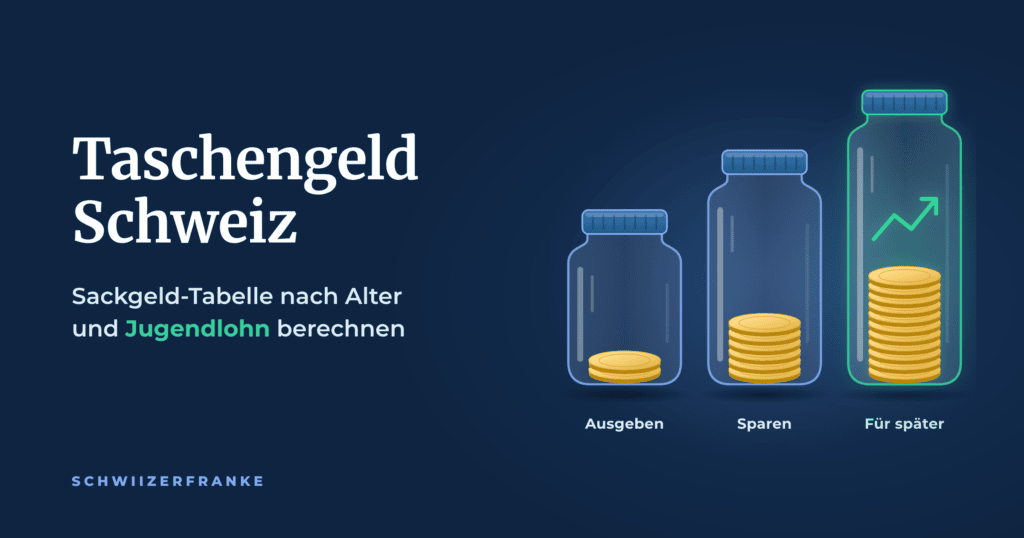
Many families use money boxes or jars: one for spending, one for saving towards a bigger treat. Some add a third jar for the future. Whatever ends up in that jar is intended for a goal many years down the line.
For such long-term goals, a securities account may be a suitable option alongside a savings account. It offers the potential for higher returns, but also involves price fluctuations and the risk of loss. Money that will be needed soon, at a specific time, is better kept in a savings account. With a share portfolio, your child can see that they can have a stake in companies – such as the one that makes their favourite chocolate or the one that manufactures their mobile phone. With a broadly diversified ETF, that means hundreds of companies from all over the world in one go. We explain how this works in our guide Investing money for children.
A long-term investment horizon helps because returns can accumulate over the years. In purely mathematical terms, CHF 50 per month over 18 years, assuming an annual return of 4 per cent after costs, amounts to around CHF 15,780. Of this, CHF 10,800 represents contributions and around CHF 4,980 represents the calculated investment return. This is a model calculation, not a forecast. The story of the … illustrates just how significant this effect has been over the decades. Josephspfennig.
Important: Investments in shares can fluctuate significantly and may remain in the red for several years. At the desired point in time – for example, when a child starts school or turns 18 – the value of the investment portfolio may be less than the amount paid in. A long-term investment horizon does not eliminate this risk.
Parents, godmothers, godfathers or grandparents can regularly set money aside for the child. Depending on the provider, the savings account may be held in the parents’ name or the child’s. This makes a legal difference, for example when it comes to who owns the money and who is liable for tax on it. You can find ideas specifically for godmothers and godfathers in the article on Godfather’s coins.
Partner · In collaboration with arvy
The arvy children’s account: Investing for your child
arvy is a Swiss provider of automated investment services. With a children’s account, a parent opens the investment account and automatically invests a fixed amount for the child every week.
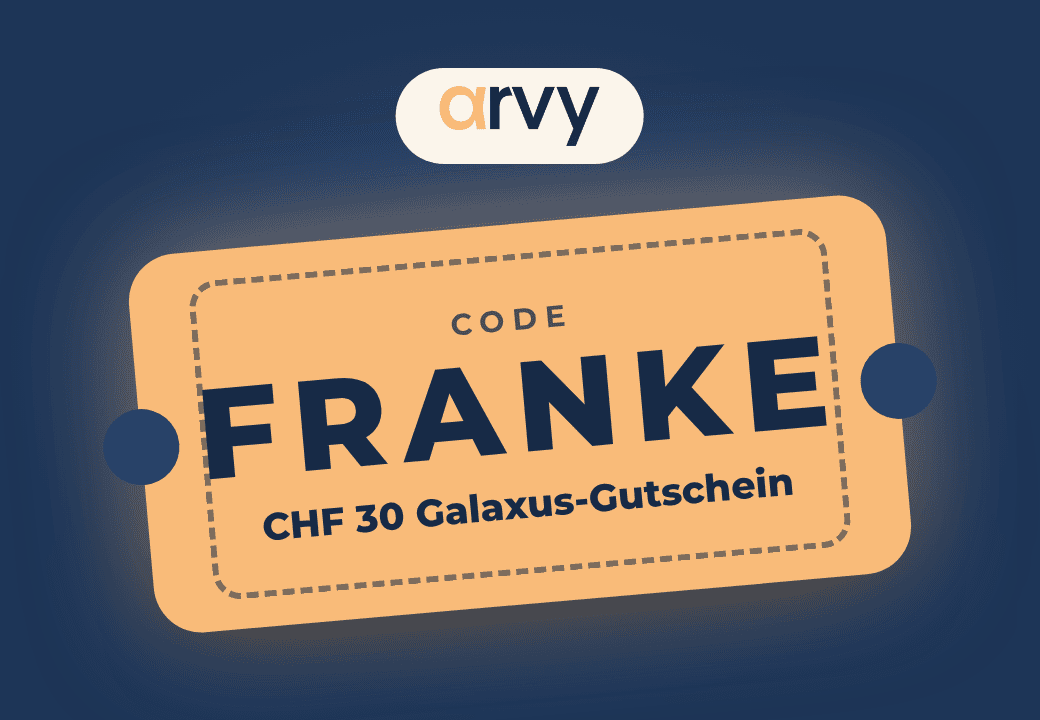
For readers of the Swiss franc: Use the code FRANKE to receive a Galaxus voucher worth CHF 30. Enter the code when you open your account, deposit at least CHF 500 and leave the money invested for at least three months. This offer applies to the children’s account and the ETF savings plan.
- Costs: «Global Market» option with passive index products, totalling around 0.49 to 0.50 per cent per annum including VAT (0.39 per cent management fee plus VAT, plus 0.07 to 0.08 per cent product costs). Custody account management, currency conversion and tax statement included; stamp duty is also payable upon purchase of the ETF
- Start: Initial deposit from CHF 500, with automatic weekly investments thereafter; can be paused at any time
- Gift: To mark the opening, arvy is giving you the children’s book *A Dog Called Money*«
Good to know: Legally, the account is held in the parent’s name, and any assets and income are taxed there. The investment account does not automatically transfer to the child on their 18th birthday. arvy is regulated by FINMA, and the securities are held by Hypothekarbank Lenzburg. Regulatory oversight does not protect against price losses; it is possible to lose the capital invested. You can find other providers of children’s investment accounts in the Comparison of children’s investment accounts. * Affiliate link: We receive a commission when you open an account; nothing changes for you.
Frequently asked questions
Pocket money in Switzerland: How much is usual?
Budgetberatung Schweiz recommends CHF 3 per week from the age of 6, CHF 35 from the age of 10, CHF 50 from the age of 12, CHF 80 from the age of 15 and CHF 110 per month from the age of 18. Many families give less. The key thing is that the amount fits within the family budget.
How much pocket money should a 12-, 14- or 16-year-old get?
According to Budgetberatung Schweiz, around CHF 50 per month at age 12, CHF 70 at age 14 and CHF 90 at age 16. If the pocket money covers additional expenses such as a mobile phone or clothes, a higher amount or a youth wage makes sense.
At what age should a child start receiving pocket money?
A good time to start is when the child starts school, at around 6 years old. By then, the child can count and understands the value of coins. It is possible to start earlier if the child shows an interest.
Do I have to give my child pocket money?
No, there is no legal obligation to do so in Switzerland. Pro Juventute and Budgetberatung Schweiz nevertheless recommend giving children a regular allowance, as it is only by having their own money that children learn how to manage it.
Am I allowed to cut my child’s pocket money as a punishment?
Better not. If pocket money is used as a reward or a punishment, the child learns something about discipline, but little about money. Budgetberatung Schweiz advises against this.
What is the difference between pocket money and a youth wage?
Pocket money is a small amount set aside for personal treats. A youth allowance is higher and covers a large proportion of expenses, such as clothes, a mobile phone and leisure activities. The child manages it themselves. Budgetberatung Schweiz recommends introducing it from around the age of 12.
How much is the youth wage at the age of 14?
There is no official table based on age. The youth allowance depends on which expenses your child pays for themselves. According to a study by the Lucerne University of Applied Sciences and Arts, it usually starts at between CHF 100 and 300 per month. For a 14-year-old with a mobile phone, clothes and hairdressing costs, the budget advice guidelines, combined with pocket money of CHF 70, work out at roughly CHF 140 to 220.
Is there a minimum wage scale for young people in Switzerland?
Not based on age. However, Budgetberatung Schweiz does provide guide figures for each category, such as CHF 10 to 30 for a mobile phone and CHF 50 to 90 for clothes in secondary school. You can work out the ‘youth allowance’ by adding up the allocated amounts for each category and the pocket money you’ve been receiving so far.
Where can I find a template for a youth wage?
The Jugendlohn association provides calculation guides and worksheets on jugendlohn.ch. The contract should include the amount, payday, the expenses covered, rules for financial difficulties, exceptions and a date for review.
What does Pro Juventute recommend regarding pocket money?
Pro Juventute recommends giving children a regular allowance and, from around the age of 12, switching to a youth wage. Pro Juventute was one of the founding organisations of the Youth Wage Association. Budgetberatung Schweiz provides guidelines on the amount of the allowance, based on age.
Conclusion: Pocket money is money for practising
The amount is less important than the rules. Pocket money that is paid on time, can be spent freely and isn’t used as a means of exerting pressure will benefit your child more than any chart. The guidelines from Budgetberatung Schweiz provide a framework; your family budget sets the limit.
And if you want to take it a step further: set aside a separate place for money to be saved for later. Your child will then not only learn how to save, but also how money can grow over the long term and fluctuate in the process.
This post was produced as part of a paid collaboration with arvy. Schwiizerfranke is responsible for the content and review. Sources: Umbrella Organisation for Budget Advice in Switzerland, Guide figures for pocket money – 2025/2026 version · PostFinance, Pocket Money Survey · Lucerne University of Applied Sciences and Arts, Evaluation of the Youth Wage Scheme · Jugendlohn Association · arvy, children's account · arvy, fees · arvy, ETF savings plan components · Budget Advice Switzerland, Guide to Pocket Money (PDF) · Calculation example: own calculation, CHF 50 per month over 18 years, 4 per cent return per annum after costs, monthly interest accrual, no forecast. No investment advice. As at 24 November 2026.