




A Bitcoin ETF tracks the price of Bitcoin and can be bought via your investment account in the same way as a share. In Switzerland, physically-backed Bitcoin ETPs have long been traded on the SIX. In October 2026, FINMA also authorised BBIT, the first Bitcoin fund under Swiss law that is open to retail investors.
Here you can find out which Bitcoin ETFs and ETPs are available in Switzerland, how much they cost, where you can buy them and what the risks are.
Key points at a glance
- Bitcoin ETF in Switzerland: What most people refer to as such is, in legal terms, often an ETP – that is, a debt instrument backed by Bitcoin.
- BBIT is the first Bitcoin fund under Swiss law for retail investors. FINMA authorised it on 20 October 2026.
- Costs: Depending on the product, the running costs range from around 0.10% to 1.5% per year. Brokerage fees and spreads are added to this.
- Ownership: You own the security, not the Bitcoin. All options are subject to the sharp fluctuations in the Bitcoin price.
- Crypto ETF: As well as products based solely on Bitcoin, there are crypto ETFs and ETPs tracking several cryptocurrencies.
- Proportion: If you want to include Bitcoin in your portfolio, 1 to 5 per cent of your invested assets is usually sufficient for most people.
What is a Bitcoin ETF?
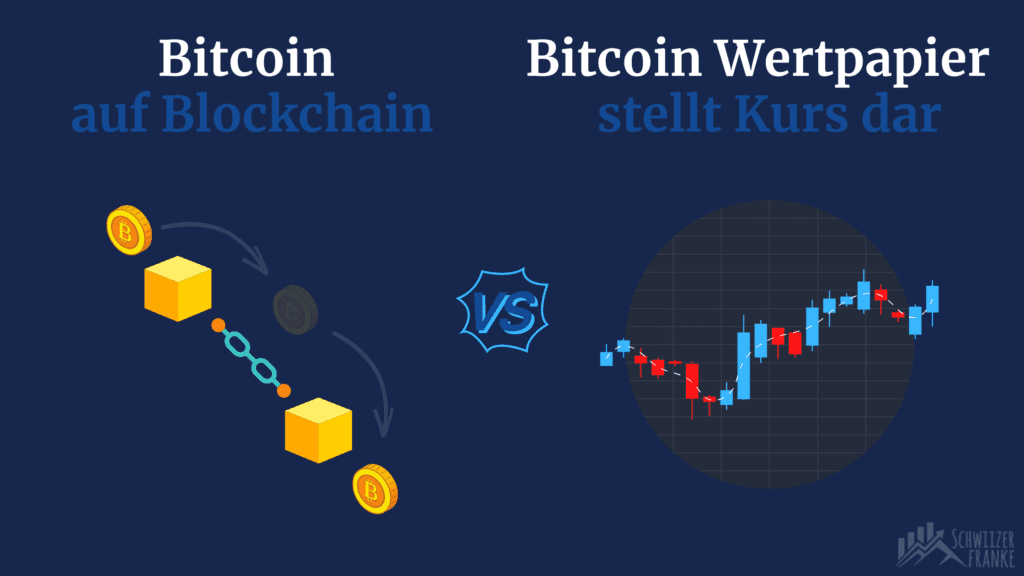
ETF stands for Exchange Traded Fund. A Bitcoin ETF, often referred to as a BTC ETF, buys actual Bitcoin and issues units in return, which you can trade on the stock exchange. If the price of Bitcoin rises, the value of your unit increases, minus any running costs. If it falls, you lose the same amount.
The first Bitcoin products often relied on futures, i.e. forward contracts on the price of Bitcoin. Today, most Bitcoin ETFs and ETPs are physically backed. Each unit is backed by actual Bitcoin held by a specialist custodian.
Important to note: You own the security, not the Bitcoin itself. You cannot send it to your own wallet or use it to make payments. However, this means you don’t have to worry about wallets, passwords or seed phrases. The Bitcoin ETF is simply held in your investment portfolio, alongside your equity ETFs.
Bitcoin ETFs, ETPs and ETCs
Swiss investors almost always search for «Bitcoin ETF». However, what they usually buy on the SIX is an ETP. The price is practically the same; the difference lies in the legal form. And that determines what happens to your money if the provider runs into difficulties.
| Term | What it is | In the event of bankruptcy |
|---|---|---|
| ETF (Fund) | Investment funds with separate portfolios | The fund’s assets belong to the investors and are held separately from the assets of the fund management company. |
| ETP or ETN | A debt security issued by the issuer; in the case of Bitcoin, it is usually physically backed | You are a creditor. The Bitcoin held in custody serves as collateral, but issuer risk remains. |
| ETC | Originally the term used for commodity ETPs; in the case of Bitcoin, it is structured in the same way as an ETP | As with the ETP |
A physically-backed ETP significantly reduces issuer risk, but does not eliminate it entirely. In the event of a problem, it depends on the legal structure of the collateral and who holds the Bitcoin in custody. In the case of a fund governed by Swiss law, however, the assets are segregated by law.
A comparison of Bitcoin ETFs and ETPs
The table shows a selection of Bitcoin products that you can trade on SIX in Swiss francs. All are physically backed by Bitcoin. Information current as at October 2026. Please check the costs in the provider’s factsheet before purchasing, as they are subject to change.
| Product | Type | ISIN | TER | CHF line |
|---|---|---|---|---|
| BBIT Bitcoin Fund ETF | Funds governed by Swiss law | not yet published | not yet published | planned |
| 21Shares Bitcoin Core ETP | ETP | CH1199067674 | 0.10% | yes |
| iShares Bitcoin ETP | ETP | XS2940466316 | 0.15% | yes |
| WisdomTree Physical Bitcoin | ETP | GB00BJYDH287 | 0.15% | yes |
| Xtrackers Galaxy Physical Bitcoin ETC | ETC | CH1315732250 | 0.25% | yes |
| 21Shares Bitcoin ETP | ETP | CH0454664001 | 1.49% | yes |
Please note: WisdomTree’s fee of 0.15% is valid until the end of 2026. From January 2027, the fee is set to return to 0.25%.
Tip: A trading line in CHF does not mean that the product is hedged against currency fluctuations. With a CHF line, you buy and sell directly in Swiss francs; a separate currency conversion by the broker is not usually necessary. However, this does not mean that the product is hedged against the US dollar, nor does it automatically result in lower overall costs.
Running costs aren’t the whole story. When you buy, you’ll also have to factor in your broker’s commission, the bid-ask spread and, where applicable, conversion fees. For small amounts, these often have a greater impact than the TER.
US spot ETFs such as IBIT
Spot Bitcoin ETFs have been authorised in the US since January 2024. The best-known is BlackRock’s iShares Bitcoin Trust (IBIT). Many Swiss brokers offer such US products, such as Swissquote.
Legally speaking, these products are trusts and not traditional investment funds, even though they have «ETF» in their name. You trade them in US dollars, which involves a currency conversion. With US securities, US tax issues may also arise, for example in the event of inheritance involving larger sums. For most Swiss investors, a product listed on the SIX in Swiss francs is therefore the simpler option.
The Swiss Bitcoin ETF, BBIT
On 20 October 2026, the FINMA has authorised the first publicly traded fund under Swiss law to invest directly in Bitcoin. The fund is managed by BIT Asset Management, based in Zurich, a subsidiary of the BIT Group. The product is called the Bitcoin Fund ETF and has the ticker symbol BBIT.
FINMA classifies the fund as an «other alternative investment fund» with a high level of risk. As it holds only Bitcoin, FINMA has granted an exemption from the usual risk diversification requirements. According to the provider, the Bitcoin is held in cold storage at a Swiss bank.
What this means for you: The fund’s assets are segregated from those of the fund management company. Unlike with an ETP, there is no comparable issuer risk associated with a debt security. However, custody and operational risks remain. Even a regulated fund cannot protect you from price losses, however. FINMA expressly emphasises that Bitcoin investments remain very risky.
As at October 2026: Trading on SIX is scheduled to begin in November 2026. The provider will publish the ISIN and fees when trading commences. Until then, you cannot yet buy BBIT.
Which Bitcoin ETF is the best?
There is no single ‘test winner’, as all the products track the same Bitcoin price. They differ in terms of costs and structure. These five questions will help you find the right product:
- Fund or ETP? If you want to minimise issuer risk as much as possible, the fund’s structure is a factor to consider.
- How much are the running costs? On CHF 10,000, 0.10% amounts to around CHF 10 per year, whilst 1.49% amounts to around CHF 149. Over many years, this makes a noticeable difference.
- Is there a CHF trading segment on SIX? This allows you to trade directly in francs.
- How large and liquid is the product? Higher volume usually means tighter spreads.
- Who are the provider and the custodian? An established issuer that provides transparent information on custody inspires confidence.
Buying a Bitcoin ETF in Switzerland
You can buy Bitcoin ETFs and ETPs just like any other share via your investment account. Most Swiss online brokers offer them, such as Swissquote or Saxo. The following will show you which broker is right for you: Online broker comparison.
- Open a securities account or use an existing one.
- Search for a product by ISIN, not just by name. That way, you’re sure to find the right product.
- Select the CHF line on SIX, if you want to buy in Franconia.
- Set a limit Instead of buying at the «best price». Bitcoin’s price fluctuates significantly, even within a single day.
A Bitcoin ETF as a savings plan
Some brokers and apps offer savings plans for crypto ETPs. By investing a fixed amount each month, you spread your purchases out over time and don’t have to choose a specific entry point. Be mindful of the costs per trade, otherwise even small instalments can end up being expensive.
With apps such as Yuh You can also buy cryptocurrencies directly. Check whether you’re buying a security for your investment portfolio or coins that the provider holds on your behalf. They’re not the same thing.
Crypto ETFs: Products covering multiple coins
Those who do not wish to invest solely in Bitcoin will also find crypto ETFs or crypto ETPs on the SIX that track a basket of several cryptocurrencies. One example is the 21Shares Crypto Basket Index ETP, with the ticker HODL, which is the first crypto ETP on the Swiss stock exchange.
In such portfolios, Bitcoin usually accounts for the largest proportion, followed by Ethereum. The remainder is spread across smaller coins, which are subject to even greater volatility. The costs are usually significantly higher than for pure Bitcoin products. From a legal perspective, crypto ETFs in Switzerland are generally classified as ETPs.
If you’re particularly interested in Ethereum, you can find out more in the article on Ether ETF.
How secure are Bitcoin ETFs?
«Secure» has several meanings when it comes to Bitcoin. Rather than asking which option is more secure overall, it is worth looking at the individual risks. Each option carries different risks.
| Risk | Bitcoin ETF (fund) | Bitcoin ETP | Your own wallet |
|---|---|---|---|
| Currency risk | full | full | full |
| Provider | Fund assets held separately | Issuer risk, backed by Bitcoin | no intermediary |
| custody | Fund custodian | The issuer’s custodian | yourself |
| Operation | minimal, goes through the investment portfolio | minimal, goes through the investment portfolio | high, wallet and seed phrase |
No product can protect you from price losses. Bitcoin has lost more than half its value on several occasions in the past. The question, therefore, is not which option is safe, but which risk you would rather take: the product risk associated with a provider, or the risk of making a mistake yourself.
A Bitcoin ETF or actual Bitcoin?
With an ETF or ETP, you can conveniently hold Bitcoin in your investment portfolio alongside your other investments. With physical Bitcoin, you own the coins yourself, can transfer them and hold them yourself. In return, you bear full responsibility for your wallet and login details.
For beginners, a custodial wallet is often simpler, as they do not have to worry about setting up a wallet or keeping their seed phrase secure. Anyone wishing to buy real Bitcoin will find that Relai a Swiss provider. You can find an overview of other platforms in the Crypto Exchange Comparison.
Does a Bitcoin ETF make sense?
A Bitcoin ETF is an easy way to add Bitcoin to your investment portfolio. Whether this makes sense for you depends on your investment objectives. Bitcoin does not generate any regular income, such as dividends or interest. Its value depends solely on supply and demand, and it is subject to high volatility.
If you want to include Bitcoin in your portfolio, keep the proportion small. For most people, 1 to 5 per cent of their invested assets is sufficient. More than 10 per cent is not advisable for most people, as the fluctuations will then have a significant impact on your entire portfolio.
This is a rule of thumb, not a requirement. If you have a broad portfolio of shares and don’t want any cryptocurrencies, you’re not missing out on any essential component. Only invest money that you won’t need in the long term, and assess how much volatility you can tolerate. The article on Risk-return ratio. The following illustrates how a small, high-risk component can be combined with a solid core: Barbell strategy.
Bitcoin in Pillar 3a
Bitcoin is also an option under Pillar 3a, though only as a small component of your portfolio. Digital providers such as finpension or VIAC allow a maximum crypto allocation of 5 per cent within a dedicated strategy (as of October 2026). The range of products available varies depending on the provider. Bear in mind that your 3a funds are tied up until shortly before retirement. You can see which providers allow what in the Pillar 3a comparison.
Taxes on Bitcoin ETFs
- Property tax: You declare Bitcoin ETFs and ETPs in the same way as other securities, using their tax value at the end of the year. You can find this value in the FTA’s price list or on your broker’s tax statement.
- Capital gains: Capital gains on private assets are tax-free, provided you are not regarded as a professional trader in securities. Frequent trading, short holding periods and buying on credit may lead to this.
- Charges on purchase: A turnover tax may be payable via a Swiss broker. The amount depends on the product and where the broker is based.
Funds and ETPs are not treated identically for tax purposes in every respect. If you are unsure, check with your cantonal tax authority or a specialist.
Conclusion
With a Bitcoin ETF or ETP, you can add Bitcoin to your investment portfolio just as easily as you would a share ETF. In Switzerland, you can choose between low-cost, physically-backed ETPs listed on SIX and BBIT, a fund governed by Swiss law. Pay attention to the structure, costs and whether it’s denominated in CHF. And keep your holding small, as no product can eliminate the price risk for you.
Frequently asked questions
Is there a Bitcoin ETF in Switzerland?
Yes. On 20 October 2026, FINMA authorised BBIT, the first Bitcoin fund under Swiss law for retail investors. In addition, physically-backed Bitcoin ETPs – which are often also referred to as Bitcoin ETFs – have been traded on the SIX for years.
What is the difference between a Bitcoin ETF and a Bitcoin ETP?
An ETF is a fund whose assets are segregated from those of the fund management company. An ETP is a debt instrument issued by the issuer, which is usually backed by Bitcoin. With an ETP, therefore, there remains an issuer risk; both are equally exposed to fluctuations in the price of Bitcoin.
Which Bitcoin ETF is the best?
There is no single ‘best’ Bitcoin ETF for everyone, as they all track the same price. Compare the structure, ongoing costs, trading in CHF on the SIX, the size of the product and the custodian.
Can I buy a Bitcoin ETF in CHF?
Yes. Many Bitcoin ETPs are listed on SIX in Swiss francs. This means you trade directly in Swiss francs. However, this does not mean the product is hedged against fluctuations in the US dollar.
Do I actually own real Bitcoin with a Bitcoin ETF?
No. You own the security, not the bitcoins. The bitcoins are held by the fund’s or issuer’s custodian. You cannot send them to your own wallet.
Can I hold Bitcoin in a Pillar 3a scheme?
Yes, as a small addition. Digital 3a providers such as finpension or VIAC allow a maximum crypto allocation of 5 per cent within a personalised strategy. The range of products available varies depending on the provider.
Is a Bitcoin ETF a share?
No. Although a Bitcoin ETF or ETP is traded on the stock exchange in the same way as a share, it does not represent a stake in a company. It merely tracks the price of Bitcoin. Shares in companies linked to Bitcoin are a different matter.
Are profits from Bitcoin ETFs tax-free?
In Switzerland, capital gains on private assets are tax-free, provided you are not considered a professional securities trader. However, you must declare the value of your Bitcoin ETF as part of your assets each year.