
 Skip to content
You want Invest in tangible assets, to you Protect against inflation or around your Diversify portfolio? You will quickly come across questions like "which wine is a good investment?" or "what return can I expect from luxury watches? Splint Invest has taken this on and Simplifies the path to a diversified portfolio clearly. The still young provider from the canton of Zug takes care of research and safekeeping, as well as all the complex questions around the topic for you.
We took a closer look at Splint Invest and the CEO Aurelio Perucca confronted with questions about this. In this article you can find out whether Splint Invest is suitable for you as an investment app and what you should be aware of.
If you have any more questions on the topic, we look forward to an exchange in the comments!
Real assets offer many pitfalls and often require a lot of expertiseto be able to really consider them as an investment. Many people are aware that an everyday car cannot usually be seen as a tangible asset. A luxury watch that one wears from time to time may look different. But why invest in tangible assets at all?
We have answered this question in detail here, but we would like to go into the topic again briefly. Particularly in uncertain times, tangible assets offer an stable value retention and are intended to protect against inflation. With expertise and patience, tangible assets can even prove to be more than just investment goods that retain value. Rather, one can Achieve respectable returns with tangible assetsalthough a layman should of course be cautious here. But this is where Splint Invest comes into play as an intermediary.
Some tangible assets are so expensive to purchase or require so much expertise to handle that they are Only accessible to a few private investors at all let alone make sense. Splint Invest offers in its app, which is a way of Shares in tangible assets in the amount of €60 are. Splint Invest therefore offers you access to tangible assets in which you can invest and receive information on the respective investment.
You can look at the factsheets of the respective goods and learn more about the tangible asset group there. You can also make your own comparisons with other indices or investments. A Assessment in terms of return and value stability is shown in the factsheet, as are the exact costs.
Your key to success! Discover our top recommendations from real testimonials.



Since the information in the Splint app is very extensive, someone could of course get the idea of using some of the Making tangible asset investments easy to do yourself. So we want to look at, Whether this really makes sense and take two examples:
"Storage and safekeeping vary from plant to plant. We work with experts and international partners - they help us to procure the plants and sometimes also take care of storage, safekeeping and insurance. However, each plant is professionally stored and insured by experts - so that nothing stands in the way of an increase in value. As an example: we are currently storing the wine in Nordic Freeport. You can get an idea here: https://www.youtube.com/watch?v=vdThe_d95mc .
We store whisky casks directly in the distillery's bonded warehouse. - so we can reduce the running costs. Smaller plantswhich have to be stored in a dry place, we also partly keep at our partner bank, the Hypothekarbank Lenzburg, in the safe - directly in Lenzburg."
"The Assets are checked for existence, authenticity and condition before purchase and before storage. Our research team is involved in this process and takes on the role of external assessor. On-site visits to suppliers and warehouses are part of the daily routine. When it comes to extremely rare plants, we always call in an external expert.
"Our partners - we run a Annual quality control at the suppliers / partners / warehouses in other words, a kind of audit. This is how we ensure that the partners comply with the quality requirements on an ongoing basis."
«We value the investments on a quarterly basis and publish the valuation in the app. In this way, our clients can see the market value of their portfolio. Our valuation can then be used as an indicator for trading (function to be activated soon) within the app. However, the valuation is only an indication. The We can only define the actual value with certainty when the plant has been sold.«
"Intelligent people learn from the mistakes of others".
We have compiled our top selection for you from all our tests and experience reports:


"Correct - important: the 2% transaction or sales fees are also charged in the event of a sale on the secondary market. The costs are borne by the seller. There are no running costs . The costs for storage and insurance are already included in the purchase price of the system and therefore in the splint price of EUR 60."
"This question is difficult to answer. Any statement would be pure speculation. What we can say, however, is that our asset classes have performed very well over the last 10 years:
What is important in any case: our Investments protect our clients' assets against inflationas the equivalent value of the physical investment rises with inflation. The investments also protect the assets from a recession or economic crisis, as the value of the investments has a lower correlation with the world stock markets. This was the incentive for us to make these asset classes, previously reserved for the "rich", accessible to all."
"The shares belong to our clients, not to us. Thus a Insolvency of our company has no influence on our customers.. Our top priority is to protect our clients - so we have ensured that if Splint Invest becomes insolvent, an independent trustee will step in and manage the investments for our clients until maturity, sell them and transfer the proceeds to the clients."
"We create a report for our clients/clients that Tax certificate - all relevant information is contained therein."
Autumn 2025: Splint Invest has expanded the app - payments can now also be made in CHF and GBP, and no longer just in EUR. This makes the platform much more attractive for Swiss investors, as exchange rate fees no longer apply.
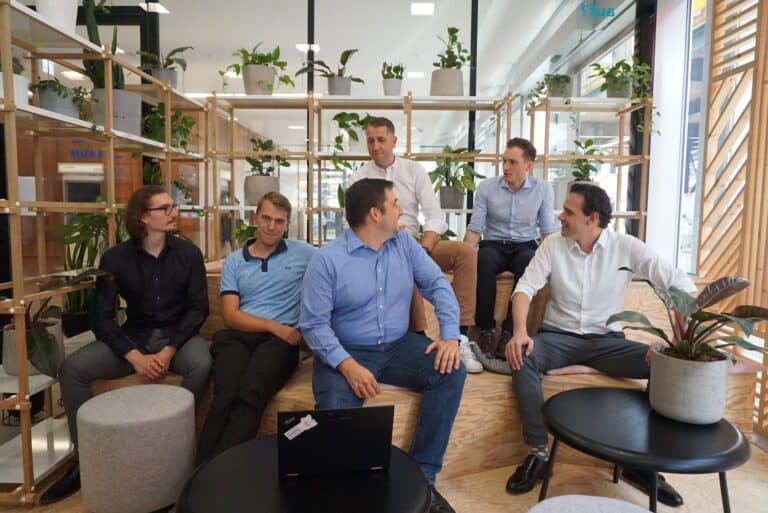
"We want to change the industry - that's why we are putting much emphasis on transparency. Ongoing and hidden costs are taboo for us. At the same time, we also think completely differently than traditional asset managers. Our processes are fully automated, paperless and simple. We want simply every person to be able to join in and participate - regardless of the experience he/she brings with him/her. By keeping costs low, our clients benefit even more from the increase in the value of their investments.
Not to forget our app of course - it is extremely easy to use. Within 2 minutes, an account is opened and you can get started. The fact that Splints can also be paid for by credit card, Google Pay and Apple Pay from 2022 will also simplify the payment process enormously."
We are excited to see where Splint Invest is heading in the future. Their timing in times of rising inflation is successful and their offering is innovative. Aurelio Perucca's team has put a lot of thought into it and developed a Innovative app created.
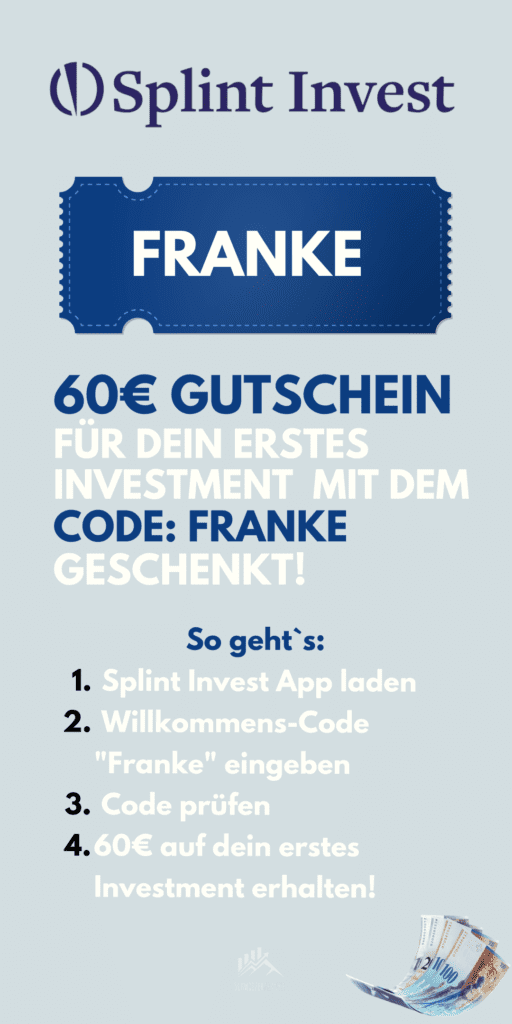
Are you convinced by the Splint Invest offer? For your first Splint Invest test, please use our Promo code to the start!
Questions about the offer? Leave your comment!
→ CHF, EUR and GBP directly in the app - no exchange rate fees for the Swiss!
→ Only 2% on sale. No running costs, storage and insurance are included in the purchase price.
→ As assets in private assets. Splint issues a tax certificate.
Transparency Note: This article was created in cooperation with Splint Invest. Nevertheless, content and presentation have been created freely and independently by Schwiizerfranke.
We use cookies to ensure that our free calculators and comparisons work perfectly. Statistics cookies also help us to improve the site for you. You decide - and can change them at any time.
I notice the following: "Our research team .... assumes the role of external appraiser (for the initial purchase)." The annual audit is also carried out in-house and the company is apparently not regulated either? I don't want to insinuate anything, but I would definitely not invest under these circumstances. Better safe than sorry.
Thanks for your input.
Cases such as Wirecard and the like have shown that even our large, renowned auditing firms (such as EY) sometimes sign off on financial statements that are missing billions 😀
There is always a residual risk, otherwise your own cellar will have to be converted into a warehouse 🙂
Dear Michael - thank you very much for your comment. How did you come to the conclusion that the annual audit is done by yourself?
The audit of our company is carried out annually by BDO (https://www.bdo.ch/de-ch/home-de). Furthermore, we (i.e. MARK Investment Holding AG) are a regulated financial institution and a member of the VQF (https://www.vqf.ch/de/). In addition, the existence of the investments is also audited annually by an external company (SME audits: https://www.kmurevisionen.ch/).
I would like to understand how you drew all your conclusions from one sentence.
Best regards
Aurelio (CEO & Co-founder of Splint Invest)
Interesting possibilities.
But - is it also suitable for small investors?
Assumption:
- I have invested €50 each in all investment categories (3)
- I am charged €3 per year for each investment category
- after an average investment period of 5 years, my €50 will still be worth €35 (!) (even less if the investment period is 8-10 years)
- This cannot be profitable for a small investor, or have I misunderstood something?
Hello Heinz, yes you have misunderstood. The research contribution of 3 EUR per asset class is only charged once if you remain inactive and simply hold your investments as in your example.
More about this directly at Splint in the FAQ.
Love!
Dear Heinz - thank you very much for your question. For your information: we have abolished the research contribution in the meantime.
Best regards, Aurelio
Interesting, may I ask if Splintinvest is registered with Finma
is regulated?
Not as far as I know. However, Splint Invest will certainly be able to tell you more about regulations etc.
Best regards 🙂
Dear Sabine - we are not directly regulated by FINMA, but by the VQF. The VQF is then regulated by FINMA. I hope I have been able to help you.
Kind regards
Aurelio
Thank you for your additions, Aurelio!
Two questions:
- Is the holding period of the investments fixed in advance or is the time horizon "forever"?
- How is the difference between the buying and selling price calculated in the trade? As Splint itself is neither a fine drinks nor a watch dealer, the help of appropriate professionals must be called upon. But these professionals also want to make a (good) living.
If Splint buys a Rolex today for 10,000 and it has a "market value" of 20,000 in 10 years' time, a watch dealer might pay 50% for it, i.e. 10,000. An auction house will take up to 25% commission (plus VAT) from the buyer and seller.
In both cases, the proceeds will be significantly below the "market value". Will this expected discount be continuously factored in or will the last splint-er simply bite the dogs?
Hello Alain,
You can see the holding period directly in the app for the respective splint. It's best to download it once and get your own impression if the topic is exciting for you.
Hello, Eric,
- Unfortunately, your answer only relates to Alain Surlemur's first question.
- Please also comment on his EXTREMELY IMPORTANT second question.
I am a very interested potential new customer and your opinion is very relevant for my final decision...
Thanks and greetings to Switzerland
Hello Socratino,
as I can imagine that this depends on the asset class (and I don't know), I am happy to pass the question on to Splint Invest.
They will post the answer here.
Dear Alain, dear Socratino
Thank you for your questions. I am happy to help.
Over the last three years, we have built up a network of partners in order to purchase assets at attractive prices and, together with our partners, to sell them at exciting prices when the time comes. We only work with validated experts in both buying and selling, thus avoiding scenarios like the one described above. You can see for yourself in the app: we have already successfully sold 5 investments and distributed the profits to our customers.
Kind regards
Aurelio
This is really interesting. I didn't know there was an app for these investments. I always thought it was out of reach for normal people. With a little bit of money, I will certainly give it a try. Thanks!
Good post, I was happy to see that there is finally a Swiss version of Timeless Investment. However, I wonder why the shares in the Swiss app are sold in euros.
Good question Andreas, I suspect this is due to the many investments on the other side in euros - this can save exchange rate fees. But I'm happy to pass the question on to Aurelio.
Hi Andreas - Eric has already answered that correctly. We buy virtually all assets in EUR. At the moment we are working on a solution so that every investor can pay in their own national currency without conversion losses. Payments in CHF will then be possible. Perhaps as an addition: compared to Timeless, we are focussing on investment-grade assets and less on collector's items that are currently in vogue (e.g. on StockX).