To provide you with an optimised experience, we use technologies such as cookies to store and/or access device information. If you consent to these technologies, we may process data such as browsing behaviour or unique IDs on this website. If you do not give or withdraw your consent, certain features and functions may be impaired.
The technical storage or access is strictly necessary for the legitimate purpose of enabling the use of a specific service expressly requested by the subscriber or user, or for the sole purpose of carrying out the transmission of a communication over an electronic communications network.
The technical storage or access is necessary for the legitimate purpose of storing preferences not requested by the subscriber or user.
Technical storage or access for statistical purposes only. Technical storage or access used solely for anonymous statistical purposes. Without a subpoena, the voluntary consent of your Internet service provider or additional records from third parties, the information stored or accessed for this purpose alone cannot generally be used to identify you.
The technical storage or access is necessary to create user profiles, to send advertising or to track the user on a website or across several websites for similar marketing purposes.
 Skip to content














Hello Eric, the article does not mention the effects of the abolition of imputed rental value and the fact that interest on debt, including mortgage interest, can no longer be deducted (except to a limited extent for new buyers). Investments in the house can also no longer be deducted by the federal government. And at cantonal level, it is not yet entirely clear whether certain items will still be allowed or not (e.g. the environment).
The whole thing comes into force on 1 January 2029!
So you have to think about how you want to deal with this now. Or no longer plan the mortgage interest deduction as a fixed tax saving over the mortgage term.
Good point, thanks Jan. The article is a bit older, I'll see if an integration makes sense, or if a whole new article makes sense!
"A mortgage costs interest, but reduces the tax burden." So far correct, every bank will tell you that. But what your bankster won't tell you is the following:
Assumption: property, value 500K, 400K mortgage at 2%, i.e. 8K mortgage that you can deduct from your taxes, income 100K. Let's assume a marginal tax rate of 25%, then you save 2K in taxes. So you pay 8K mortgage, save 2K tax, leaving net expenses of 6K + maintenance of the property.
Same property, debt-free: you pay 2K more tax, but save the 8K mortgage interest. Maintenance etc. remain the same. The bottom line is that you have 6K more in your account.
And if you don't want to give the money to the taxman, you can also donate the corresponding amount. You get exactly the same deduction.
Of course you can argue that it is better to have the (cheap) mortgage and invest the additional equity. This may also work out in the long term, but this calculation usually forgets something important: The risk. If you invest 400K in the stock market today, prices can plummet 50% the day after tomorrow and take years, or even decades, to recover (example, 60s, oil crisis of the 70s, Japan). The recovery can take much longer than your fixed-rate mortgage runs. And if the bank then comes up with the idea that you need to inject more equity in the short term, you have a problem. You can do this if you have enough money to repay the mortgage out of petty cash at any time, but not if everything is on the edge.
By the way: Have you ever read a mortgage contract? Read it properly, including the small print? That's the finest rubber. If interest rates rise massively, the bank will always find a reason to cancel your "fixed-rate mortgage". There are so many clauses that can be interpreted. Have some fun and read through them with a critical eye. And remember the old saying "A banker is someone who lends you an umbrella when the sun is shining, but wants it back as soon as the slightest cloud appears"
Many thanks for the entertaining additions, Alain 🙂
Of course, the risk should never be forgotten. But let's stick to the facts: In the last 90 years, there have only been three 10-year periods in which our stock market posted a negative return (Source). And even in these three exceptions, the return was only between 0% and -2.5%. Positive returns were achieved in all other periods.
10 years should be a good guideline for the example with the fixed-rate mortgage. It looks even better for longer periods! 🙂
Greetings,
Eric
Hello, Eric.
Thank you for this valuable contribution. I have the following questions; 1) does a pledge automatically mean indirect amortisation?
2) If I amortise indirectly & keep my 3A balance invested, it is theoretically possible that I could be in the red at the end of the term, i.e. after 15 years (unlikely, but theoretically possible with a high equity ratio in the 3A custody account).
How do you see it?
3) Can you give an example where pledging or indirect amortisation would not be financially worthwhile?
Love!
ps: diligently recommend your expertise! 🙂
Hello Dion,
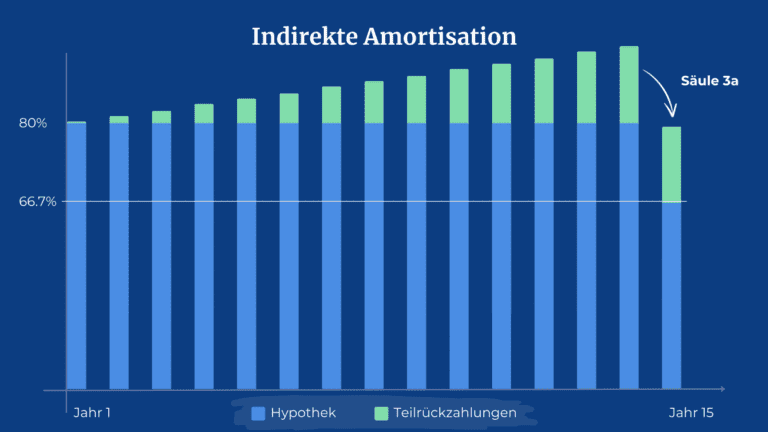
1.) Pledging and indirect amortisation: Pledging pillar 3a does not automatically lead to indirect amortisation. In the case of a pledge, the pension capital serves as collateral for the bank, but the capital remains in the pension fund and is not automatically used to repay the mortgage. Indirect amortisation means that you continue to make contributions to pillar 3a and only use them to repay the mortgage at the end of the term, usually on retirement.
2.) Risk with indirect amortisation with shares: It is true that with indirect amortisation, where the 3a assets remain invested in shares, there is theoretically a risk of loss. This depends heavily on market conditions. In the long term, however, equities offer a positive return, and historically there has not been a 15-year period with a loss on the Swiss equity market. However, this is no guarantee for the future.
3.) Exemplary situation in which a pledge might not be financially worthwhile: If mortgage interest rates rise very sharply and stock market returns are very poor for a very long time.
I hope these additions help you 🙂
There are a few mortgage providers who even allow 100% gross loan-to-value. So if you have enough 3a account/deposit/policy (or 3b policy) to pledge 10% of the purchase sum and secure the other 10% by pledging the pension fund, this is possible. However, affordability is often a problem with such a high mortgage, as a lot has to be amortised directly/indirectly and this is included in the calculation.
So the basic message of the article is absolutely correct, there are alternatives to the classic 80/20 model!