


Swiss Market Index Brief Portrait
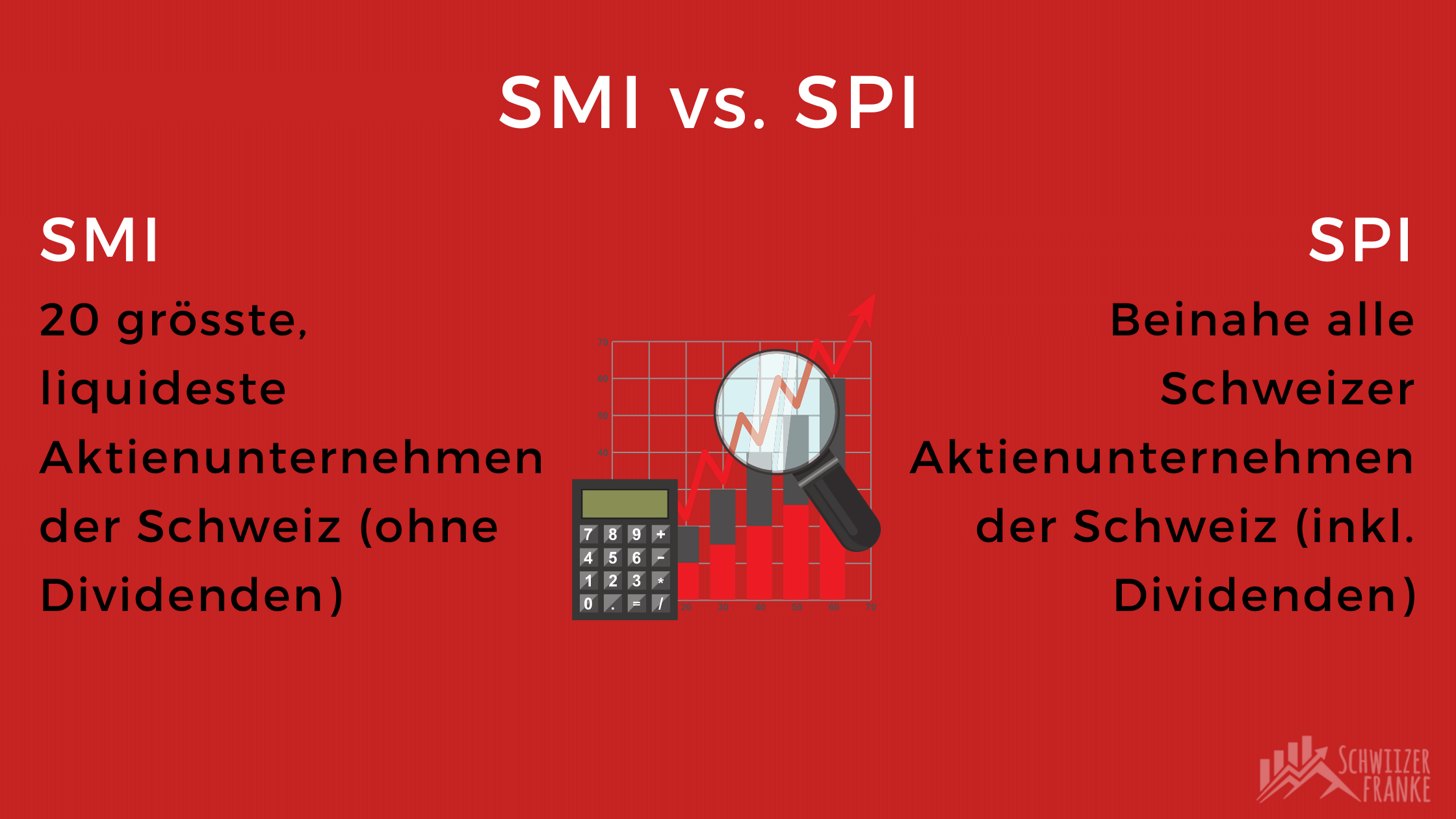
The Swiss Maket Index (SMI) forms the 20 largest and most liquid shares of the Swiss Performance Index shares. Compared to the Swiss Performance Index (SPI), it therefore does not cover all the shares traded on the Swiss Exchange (SIX).
The 20 shares of the SMI are mainly composed of the Pharmacy and chemistrybut also Banks and insurance companies and account for around 90 % of the market value and around 90 % of the trading volume on the SIX (Swiss Exchange).
Alone 60 % currently fall on the three titles Nestle, Novartis and Roche. Keyword: Cluster risk!
The SMI is also the underlying of many financial products from the derivatives sector or also different ETF SMI and other ETFs on the Swiss market.








Dear Eric
The UBS ETF (CH) SPI (CHF) A-dis now has a TER of 0.09% and not 0.15%
Thanks for the tip, it has been adjusted and the new SPI accumulator variant has also been added
Dear Eric
Thank you very much for your super exciting contributions!
I have another question on the subject of Swiss ETFs and special assets. Most of our ETFs do not have a Ucits label and are not classified as special assets according to the EU standard. How do I know that an ETF from the SPI or SMI is still safe and where can I look this up?
Kind regards Nicole
Dear Nicole
Thank you for your praise and the great question! A quick all-clear: Swiss ETFs without a UCITS label are also special assets and therefore protected. UCITS is an EU regulation that simply does not apply in Switzerland. Instead, the Collective Investment Schemes Act (CISA) applies here, which regulates investor protection in the same way. The fund assets are held separately by an independent custodian bank and do not appear on the fund management company's balance sheet. In concrete terms, this means that if the ETF provider goes bankrupt, your assets are legally segregated in favour of the investors - you get your money back.
If you want to check this for a specific ETF, look in the factsheet or the fund prospectus. There you will find the legal form (e.g. «contractual investment fund under Swiss law») and the name of the custodian bank. You can also check on the FINMA website (finma.ch) whether the fund is regulated and authorised. And as a general rule, if an ETF is listed on the SIX Swiss Exchange, it is subject to Swiss regulation and FINMA supervision.
So don't worry - SPI and SMI ETFs from providers such as UBS, iShares or Swisscanto are just as safe as UCITS products, simply in accordance with Swiss rather than EU law. 🇨🇭
Kind regards
Eric
It remains to be seen whether the Swiss equity market will also perform better in comparison over the next few years. In principle, an ETF on the MSCI World has performed better over the last few years (>5). However, ETFs on the Swiss market in particular performed significantly better in 2025. If so, then it would be a short-term addition. I see it more as a bet on the Swiss market and speculation on further depreciation of the US dollar.
Hi Eric! Thanks for the article. Do you know why the SMIs are predominantly distributing and rarely accumulating? Do you see any advantages or disadvantages to this?
Hi Dani,
Most SMI ETFs are distributing because many Swiss investors - especially institutional or wealthy investors - attach importance to regular distributions.
One advantage: you get direct cash flow.
One disadvantage: if you invest privately outside of a pension scheme, you have to pay tax on the dividends every year, even if you reinvest them.
Accumulating ETFs would often be more tax-efficient in the long term - but are rare in the Swiss context.
Hello, everyone,
Find the post fascinating, thanks for that.
How does the tax concession for Swiss ETFs compare with that for foreign ETFs?
Simply less federal stamp duty. Stamp duty, or do you notice the benefit only after the tax return?
Thanks for your feedback 🙂
The subject of taxes is not entirely trivial. But in simplified terms, it can be summarised with regard to dividends: With an ETF domiciled in Switzerland, all withholding taxes can be reclaimed (via a few detours).
For a foreign domiciled ETF, it depends on the country. A typical MSCI World domiciled in Ireland (where there is a tax treaty between the US and Ireland) will typically lose 15% of withholding tax to the US on its way to you. In some cases you can also claim this, but it is usually quite time-consuming, which is why it is not worth the effort for most investors.
There are still X number of exceptions and distinctions - I hope this brief summary was correct. If anyone sees a mistake, please let me know 🙂