

Risk capacity vs. risk appetite: difference, explanation, definition

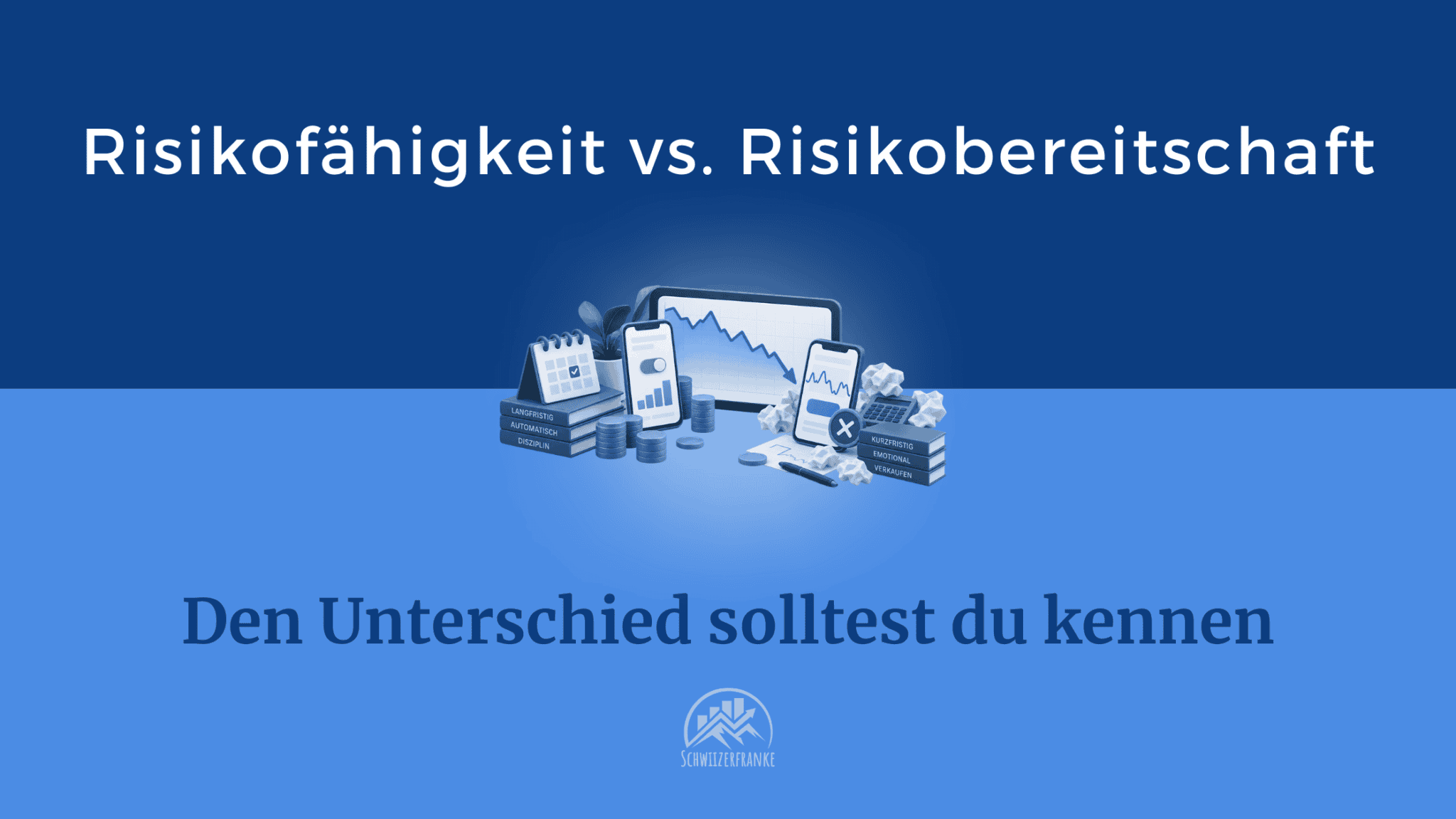
Risk capacity vs. risk appetite: the difference that almost everyone confuses

Imagine two investors. Both have invested CHF 100,000, both are following the same strategy, and both are investing in the same ETFs.

Then the market crashes. Within a few weeks, both account statements show a balance of CHF 70,000.

One person closes the app and lets their standing order run. They don’t check it again until months later. The other sits at the kitchen table, works out how much it costs each day, and ends up selling everything.

Same figures, same portfolio, opposite decision. Not because one of them is any cleverer. But because they have never clearly distinguished between the two questions.

Table of contents

The two questions to ask before making any investment decision

Two questions that sound similar but measure completely different things.

Risk tolerance: Can you afford a financial loss? That is an objective question. It depends on your circumstances, not on you as a person. It is something that can be assessed.

Risk appetite: Can you cope with the loss emotionally? That’s a subjective matter. It only becomes apparent in a crisis, not in a questionnaire.

The mnemonic for this is:

Anyone who answers only one of the two questions is building on a half-finished foundation.

What determines your risk tolerance

Seven factors, in this order.

  1. Your investment horizon. By far the most important factor. Money that you’ll need in two years’ time shouldn’t be invested in shares. No matter how stable your income is, money that’s left untouched for thirty years can weather any setbacks.
  2. Your nest egg. If you don’t have a financial buffer, you’ll be forced to sell at the worst possible moment. Not because you want to, but because the washing machine breaks down. For many people, three to six months’ worth of living expenses is a good benchmark. Above all, it is important that this financial buffer is kept separate from your investment portfolio. You can work out here how much makes sense for you.
  3. What’s left of your income. It is not the amount that matters, but the leeway. Two people each earn CHF 7,000 net. After all their fixed expenses, one is left with CHF 1,800, whilst the other has only CHF 400 left. Although their incomes are the same, their risk tolerance is not the same. Anyone who also has an irregular income or is in a precarious employment situation will need greater financial reserves before the same proportion of shares becomes sustainable.
  4. Your financial responsibility towards others. Children, a partner with no income of their own, or financial support from your parents all increase the portion of your budget that you cannot simply cut back on. If you’re only responsible for yourself, you can cut back on your spending in a difficult year and wait it out. If you’re also responsible for others, however, you usually need a larger financial buffer. The overall situation remains the key factor, though: income, savings and fixed commitments must always be considered together.
  5. Home ownership and mortgages. A mortgage is not a consumer loan; however, it does increase your ongoing financial commitments. Interest, capital repayment and maintenance costs continue to accrue even if your investment portfolio is currently showing a significant loss. It is therefore crucial to ensure that your budget still allows sufficient leeway, even in the event of higher interest rates or a lower income. Particular caution is required if securities or a 3a securities solution are used as collateral for the mortgage. In such cases, property financing and stock market risk may be more closely linked than it appears at first glance.
  6. Costly debts. Credit card balances or consumer loans outperform any foreseeable return on shares. As long as these are running, the question of the equity allocation is of secondary importance.
  7. Upcoming major expenses. The factor that almost everyone overlooks. A home, the children’s education, a sabbatical. If a large sum is due in four years’ time, your ability to take on risk is reduced today, not just then.


These seven points are facts about your situation. They are not opinions about yourself. That is precisely what makes it verifiable.

The distinction between risk capacity and risk appetite is an established part of financial planning. These factors are based on research into life-cycle investing, which demonstrates the extent to which secure future income influences the appropriate equity allocation.

Why you overestimate your risk tolerance

The second question is the more honest one. And the more uncomfortable one.

In this quiet market, almost everyone says they can cope with a 30 % decline. That does sound feasible. A figure on paper.

Now work it out in Swiss francs. For the CHF 100,000 from the example above, that’s CHF 30,000. A sum you’ve spent years saving up, and which is simply no longer there. You won’t make it up overnight, but over months. Perhaps even years. And whilst you wait, nobody tells you when it will be over.

«Minus 30 %» sounds like a number. «CHF 30,000 gone’ suddenly feels quite different.

Added to this is a pattern that is remarkably consistent: in a bull market, many people overestimate their risk tolerance. It is only when the market crashes that they realise just how low it actually is. That is why a risk assessment questionnaire completed when the going is good tells you little about how you will behave when the storm hits.

On paper, everyone can cope.

The The question of when it is really the right time to sell, you’d be better off answering that now rather than in the middle of a market slump. Falling prices are the worst possible time to make a fundamental decision. A look at the Market trends over the decades It’s more helpful beforehand than any analysis carried out in the heat of the moment.

Top recommendations for 2026

Your key to success! Discover our top recommendations from real testimonials.

The four combinations

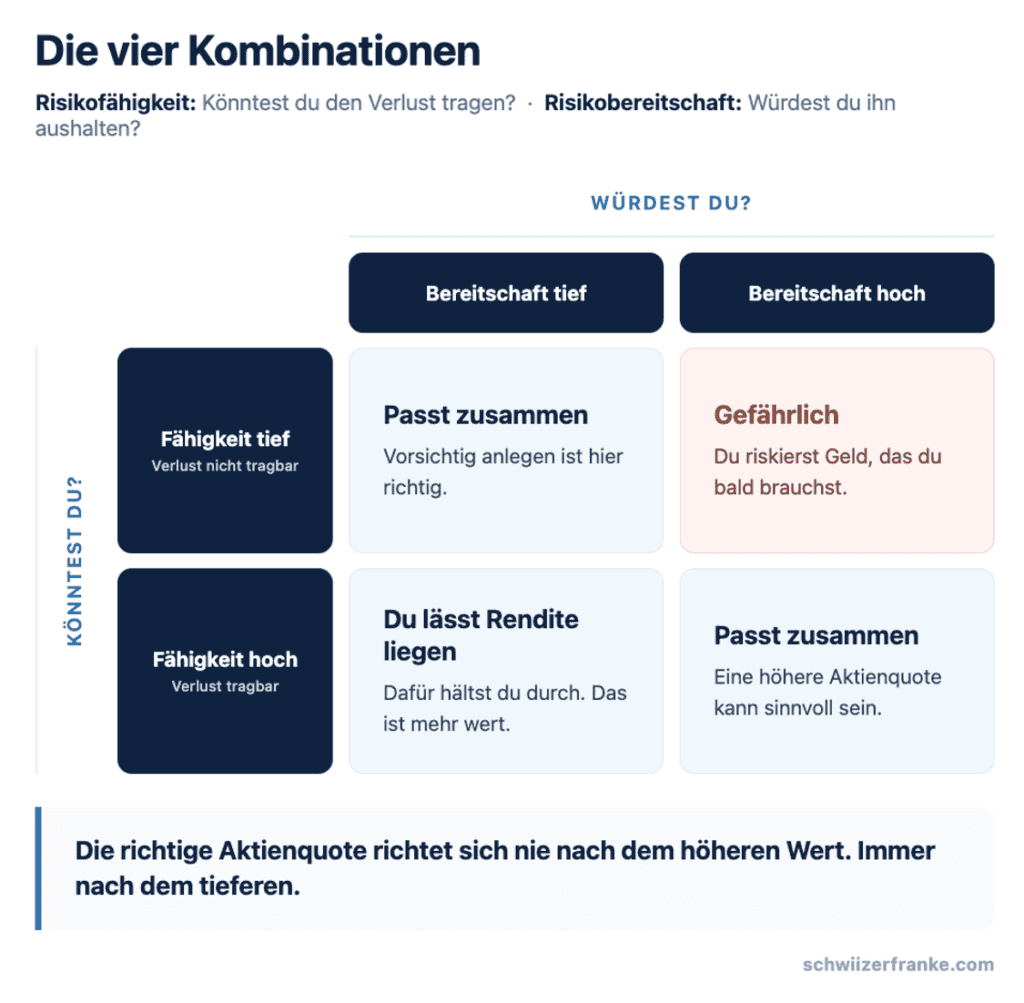
Once you’ve answered both questions, you’ll end up in one of four sections.

Risk capacity vs. risk appetite: The difference that almost everyone confuses 2

The box at the bottom left represents the most common scenario, and it is not a weakness. Many people believe they have to make full use of their high risk tolerance. They don’t have to.

If you can sleep soundly with 60 % shares but not with 100 % shares, then 60 % shares are the better strategy. Not because it is theoretically optimal, but because you can stick to it. A strategy that you abandon is no strategy at all.

What I did myself: I started small and gradually increased the proportion over the years, after experiencing a few setbacks. It took longer than it should have. But I never gave up.

The box in the top right-hand corner is the dangerous one. High risk tolerance coupled with low financial literacy means you’re happy to risk money that you’ll need in three years’ time for a deposit on a house. The market isn’t interested in your gut feeling.

Three steps to determining your equity allocation

Firstly: Check your ability. Go through the seven factors. Start with your long-term goals, then your savings, your financial flexibility, responsibility for others, home ownership, debts and upcoming expenses. These form the basis for everything else.

Secondly: Test willingness in Franconia. Not as a percentage. Work out exactly what a 30 % drop would mean for the amount you’ve planned. Have a look at the figure. If it’s keeping you awake at night, your equity allocation is too high.

Thirdly: Take the lower value. Not the average, not the one you prefer. The lower one.

Next comes implementation, and that’s the least exciting part. And that’s exactly the good thing about it. Instead of constantly tinkering with their strategy, many opt for a automatic ETF savings plan or a simple investment solution that doesn’t take up all their time in their day-to-day lives.

One possible solution is Zak Invest. You invest directly via Bank Cler’s banking app, without the need for a separate brokerage account or a second login. Simply activate Zak Invest directly within your Zak account, and you can invest easily and hassle-free in over 12,000 shares, ETFs and funds. For anyone who has set their equity allocation and wants to replicate it with just a few broad-based ETFs, this significantly lowers the barrier to entry. If you’d like to know who this is suitable for and what the limitations are, you’ll find all the details in my detailed Zak-Invest review.

Especially during turbulent times, it helps if your investments continue automatically. That way, you don’t have to reassess every market movement. The savings plan is already up and running before you’ve even had a chance to think about whether now is a good time.

Our financial tips for 2026

"Intelligent people learn from the mistakes of others".

We have compiled our top selection for you from all our tests and experience reports:

Conclusion

Answer both questions, not just one. And base your equity allocation on the lower of the two figures.

This applies to anyone who invests or is thinking of starting to invest. The reason is simple: if you only know your risk tolerance, you’ll build a portfolio that you won’t be able to hold onto during a market crash. If you only know your willingness to take risks, you’ll risk money that you’ll need soon.

There is one clear exception. With a short investment horizon, your risk tolerance is so low that your willingness to take risks hardly matters at all. Whether you could cope with market fluctuations is of secondary importance if you need the money in two years’ time.

The next sensible step: determine your equity allocation for each specific goal, rather than applying a blanket figure to your total assets. The answer for buying a home in five years’ time is different from that for retirement in thirty years’ time.

The best strategy isn’t the one with the highest expected return. It’s the one you’ll still stick to even during the next stock market crash.

Frequently asked questions

Yes, and on an ongoing basis. A change of job, having a child, buying a home, a significant change in your income or the repayment of a consumer loan can all have a noticeable impact on them. Review them once a year and whenever there’s a major change in your life.

Yes. Many people start off cautiously and only increase their equity allocation once they’ve experienced minor price fluctuations for themselves. That’s a sensible approach. The important thing is that you make adjustments deliberately and don’t react in the midst of a stock market crisis. What should I do if there’s a big gap between my ability and my willingness?

You choose the lower value and are perfectly happy with it. If your willingness is low but your ability is high, you can gradually increase the ratio later on, once you’ve gained some experience. Conversely, there’s no leeway: A high level of willingness is no substitute for a lack of ability.


To some extent. The traditional risk questionnaire often conflates the two and asks questions about how you feel when the market is calm. The result is a self-assessment, not actual behaviour. Use the questionnaire as a starting point, not as an end in itself.


Your personal risk tolerance applies to everything. However, your investment horizon varies depending on your goal, and this is the most significant factor. Therefore: you should have a different equity allocation for each goal, rather than a single allocation for your entire portfolio. You can find out more about the basics in the article Investing money in Switzerland.

Transparency notice: This article was created in collaboration with Zak from Bank Cler. The content and presentation have nevertheless been freely and independently designed by Schwiizerfranke.

The information on Zak is intended exclusively for persons domiciled in Switzerland. A Zak account can only be opened with domicile in Switzerland.

Financial author Eric Marschall certified investment advisor (IAF) independent financial expert Switzerland - certified financial expert switzerland
About the author

Eric is the founder of Schwiizerfranke.com and certified IAF wealth advisor. Since 2019, he has been helping Swiss citizens to organise their finances comprehensibly, independently and efficiently.

📌 Note: This article is for information purposes only and does not constitute personalised investment advice.

Write a comment

Your e-mail address will not be published. Required fields are marked with * marked.

Get your free
Investment Guidebook
receive!