To provide you with an optimised experience, we use technologies such as cookies to store and/or access device information. If you consent to these technologies, we may process data such as browsing behaviour or unique IDs on this website. If you do not give or withdraw your consent, certain features and functions may be impaired.
The technical storage or access is strictly necessary for the legitimate purpose of enabling the use of a specific service expressly requested by the subscriber or user, or for the sole purpose of carrying out the transmission of a communication over an electronic communications network.
The technical storage or access is necessary for the legitimate purpose of storing preferences not requested by the subscriber or user.
Technical storage or access for statistical purposes only.
Technical storage or access used solely for anonymous statistical purposes. Without a subpoena, the voluntary consent of your Internet service provider or additional records from third parties, the information stored or accessed for this purpose alone cannot generally be used to identify you.
The technical storage or access is necessary to create user profiles, to send advertising or to track the user on a website or across several websites for similar marketing purposes.




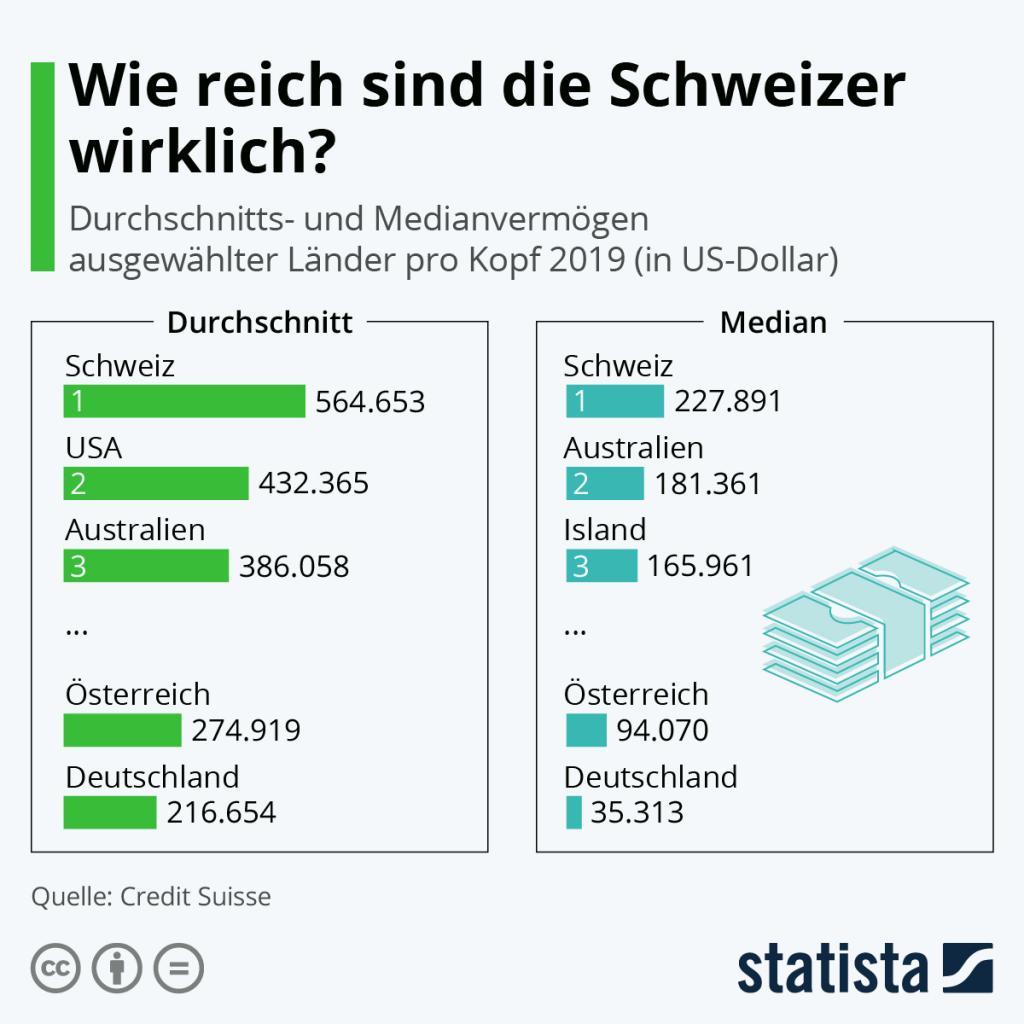










I find comparisons between different countries very difficult. In Switzerland, in particular, the attribution of pension fund assets to private assets totally distorts the picture.
It is true that the PF assets belong to you and in certain cases you can dispose of them. However, if the money is (pre-)withdrawn, this reduces the pension in old age. In this respect, it would be the same as if someone (e.g. in Germany) could mortgage/pledge his future pension (regardless of whether this is possible in practice or not). So, for a fair comparison, wouldn't the present value of future pensions have to be counted as assets, regardless of the pension system?
This way, the comparison would at least be balanced. For many people in Switzerland who convert their retirement assets to 100% as a pension, the pension fund assets are ultimately also only of a theoretical nature all the time and are not in private assets at any time.
I am completely with you, Hugo. Unfortunately, a key problem here is the data situation. Since official data is collected this way as far as I know, it's hard to make any other comparison. If you find reliable data, feel free to forward it to me at any time.
As for other pension systems with less flexibility, I don't think they should be included in a net worth determination.
If net assets are compared internationally, the purchasing power should actually also be taken into account. Or what do you think?
Incidentally, in the German example, no "equity pension" is implemented and it is purely a matter of savings assets. Swiss pension funds have a good 20% - 40% equity ratio and, in combination with the long investment horizon, can generate considerable compound interest growth. This is one of the reasons why pensions in Germany are lagging far behind.