



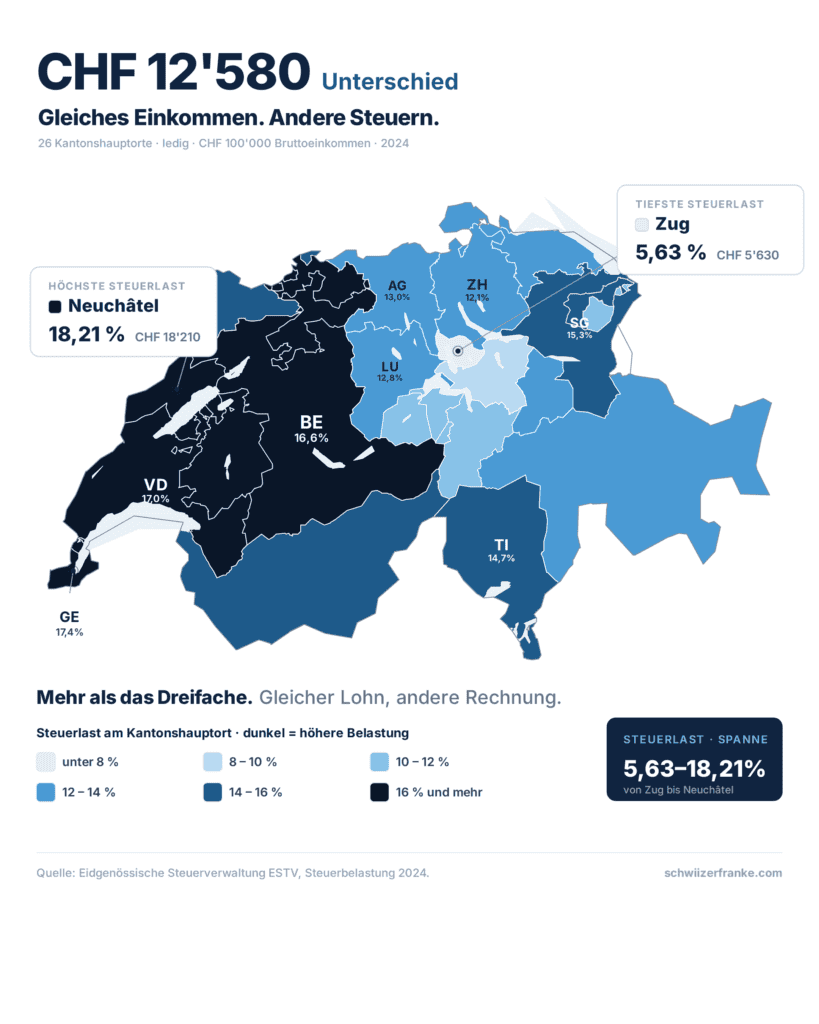
Tax burden by canton: CHF 12,580 difference for the same salary
Two people. Both single, no children, no church tax. Both earn CHF 100,000 gross.
Place of residence: Zug: CHF 5,630 in tax.
Place of residence: Neuchâtel: CHF 18,210.
Difference: CHF 12,580. Every year.
The figures are correct. They are taken from the statistics of the Federal Tax Administration.
But the most interesting insight isn’t to be found between Zug and Neuchâtel. It’s to be found amongst all the others.
What is actually being compared here
Every year, the FTA calculates the same sample case for all 26 cantonal capitals, taking into account federal, cantonal and municipal taxes combined.
The example case:
- single person
- without children
- excluding church tax
- CHF 100,000 salary before any deductions
- Residence in the respective cantonal capital
There are two important points to note here.
Federal tax is included. We’ve been asked about this a lot. It’s the same across the whole of Switzerland. The difference between places therefore stems solely from the canton and municipality.
And because the salary is exactly CHF 100,000, the percentage corresponds directly to the amount in Swiss francs. 5.63 per cent is CHF 5,630. That’s handy, but this calculation no longer works for any other salary.
Why these differences exist in the first place: each canton sets its own tax rates, and each municipality also determines what percentage of these it levies. Two municipalities within the same canton may therefore have different costs of living. This is even more true of two different cantons.
The ranking is not a ranking of the cantons
This is where the most important caveat lies, and it is almost always overlooked.
What you see on the map is not «the cheapest or most expensive canton». It is the result for a single household at 26 specific addresses.
Change your life circumstances, and the order may shift. Married instead of single. Two incomes instead of one. Children. Church tax. Home ownership. Assets. For married couples, there is also the Marriage penalty comes into play, the impact of which varies from canton to canton.
Even the CHF 100,000 is just an estimate. The Median wage in Switzerland is CHF 7,024 per month. The example case therefore earns an above-average salary. And because higher salaries are taxed at a higher rate, the differences may vary for a different salary.
An example that is likely to surprise many people.
In this example, the city of Zurich ranks 7th. CHF 12,120, which is CHF 1,700 below the median. Many people consider Zurich to be expensive in terms of tax. For this household, however, it is not.
And one more thing: the map shows cantonal capitals, not the cantons themselves. The cantonal capital may be quite a long way from the rest of the canton. So anyone living in the same canton but not in the capital may therefore pay a completely different amount to the figure shown on the map.
Here are all 26 values:
| rank | cantonal capital | Taxes | Distance from the centre |
|---|---|---|---|
| 1 | Zug (ZG) | CHF 5,630 | −8,190 |
| 2 | Schwyz (SZ) | CHF 9,550 | −4,270 |
| 3 | Appenzell (AI) | CHF 10,350 | −3,470 |
| 4 | Sarnen (OW) | CHF 11,510 | −2,310 |
| 5 | Altdorf (UR) | CHF 11,520 | −2,300 |
| 6 | Stans (NW) | CHF 11,620 | −2,200 |
| 7 | Zurich (ZH) | CHF 12,120 | −1,700 |
| 8 | Schaffhausen (SH) | CHF 12,320 | −1,500 |
| 9 | Glarus (GL) | CHF 12,760 | −1,060 |
| 10 | Lucerne (LU) | CHF 12,810 | −1,010 |
| 11 | Chur (GR) | CHF 12,970 | −850 |
| 12 | Aarau (AG) | CHF 13,000 | −820 |
| 13 | Frauenfeld (TG) | CHF 13,210 | −610 |
| 14 | Herisau (AR) | CHF 14,430 | +610 |
| 15 | Bellinzona (TI) | CHF 14,700 | +880 |
| 16 | Basel (BS) | CHF 14,770 | +950 |
| 17 | Sion (VS) | CHF 15,040 | +1,220 |
| 18 | St. Gallen (SG) | CHF 15,250 | +1,430 |
| 19 | Delémont (JU) | CHF 15,700 | +1,880 |
| 20 | Solothurn (SO) | CHF 16,050 | +2,230 |
| 21 | Freiburg (FR) | CHF 16,480 | +2,660 |
| 22 | Bern (BE) | CHF 16,640 | +2,820 |
| 23 | Liestal (BL) | CHF 16,890 | +3,070 |
| 24 | Lausanne (VD) | CHF 17,000 | +3,180 |
| 25 | Geneva (GE) | CHF 17,350 | +3,530 |
| 26 | Neuchâtel (NE) | CHF 18,210 | +4,390 |
Source: FTA, Tax burden in cantonal capitals in 2024. The median figure is CHF 13,820. Thirteen towns are below this figure and 13 are above it.
The real insight lies in the distribution
And now don’t look at the edges any more, but at the row in between.
Zug is the outlier. Not Neuchâtel.
Zug is CHF 8,190 below the average. Neuchâtel is CHF 4,390 above it. The most expensive cantonal capital is therefore only just over half as far from the average as the cheapest one.
The biggest leap happens right at the start.
The fare from Zug to Schwyz increases by CHF 3,920. Just one seat.
It’s another eleven places from Schwyz to Frauenfeld. That comes to a total of CHF 3,660.
The gap between first place and second place is therefore greater than that between second place and thirteenth place.
Sarnen: CHF 11,510. Altdorf: CHF 11,520.
A difference of ten francs. Over the whole year.
Nevertheless, the two are in different ranks and are shown in two different colours on the map.
19 out of 26 main towns fall within a range of CHF 6,000.
So, within CHF 3,000 either above or below the midpoint. If Zug is excluded, the gap between the lowest and highest values shrinks from CHF 12,580 to CHF 8,660. A single town accounts for almost a third of the entire range.
On the map, this looks like subtle gradations. The figures behind them are much more concentrated.
That doesn’t mean the differences don’t matter. CHF 3,000 a year is a lot of money. What it means is that if we exclude Zug and Schwyz as particularly affordable county towns, the field narrows down very quickly.
What actually remains of a tax benefit
Up to this point, we’ve only been talking about taxes. Now we’re moving on from that. Because when I I shared the card on LinkedIn, the same objection kept cropping up time and again within a few hours: What’s the point of the tax benefit if I end up giving it back through my housing costs? That’s a fair question. And it can be answered without resorting to unreliable average rents. Simply work out the tax benefit on a monthly basis. Zug to Neuchâtel: CHF 12,580 a year is CHF 1,048 a month. That’s the key figure for your cost analysis. How much does it cost to live in Zug? more than CHF 1,048 extra per month, the tax benefit is, in mathematical terms, exhausted. If your additional costs are lower than this, part of it remains. The handy thing about this is that you don’t need any statistics. You simply use your own figures.And then there are the health insurance premiums
In 2026, the average monthly premium across Switzerland will be CHF 393.30. In Ticino, the figure is CHF 501.50, in Zug CHF 264.50. That’s around CHF 2,840 difference per year. So, when it comes to health insurance alone, the differences can be greater than the tax differences between many main towns. However, there is a specific reason for Zug’s low figure. In 2026 and 2027, the canton will cover 99 per cent of the costs for treatments involving hospitalisation. Normally, the cantons cover at least 55 per cent. This additional relief is limited to two years. Location advantages aren’t set in stone, after all. When it comes to the general price level, the data available quickly becomes scarce. There are no reliable statistics to tell you how much a week’s shopping costs in Zug compared to Neuchâtel. That’s why I’m not making that claim.And what about compound interest?
The objection was raised as well. Calculated simply on the basis of a 5 per cent return, CHF 12,580 per year over 40 years amounts to around CHF 1.5 million. The extent to which this effect persists over long periods is demonstrated by the Josephspfennig even more drastically. However, you can only invest the portion that actually remains after higher costs have been deducted. Compound interest isn’t the problem. It’s the assumption behind it. By the way, if you want to work out the cost based on your specific place of residence, you don’t need a tool from me. The FTA tax calculator and wheretolive.ch do this at local council level.The lever that you can actually control
That leaves the question which, for most people, is more important than «Where should I live?». Namely: What options do I have where I already live? The crux of the matter lies in the basis for comparison used in these statistics. The FTA calculates using the salary before any deductions. Your actual tax bill, however, is based on what remains after the deductions have been made. For most people, the largest deductible item is the Pillar 3a. Anyone who is a member of a pension fund will be entitled to up to CHF 7,258 pay in and claim the full amount back. How much of this you actually get back in tax depends mainly on your income and where you live. To find out which option suits you best, compare 3a at the bank, as a policy or in a custody account. In addition, there are voluntary contributions to the pension fund. These often allow for significantly larger tax deductions and, depending on your circumstances, can be planned over several years. An important caveat in this regard: A purchase isn’t automatically a good idea just because it saves on tax. The money is tied up in the long term, and your personal pension situation needs to be suitable for this. The tax saving is one factor amongst many. It isn’t the only one. I explain how the three pillars work together in the 3-pillar principle. And so, to give an honest assessment. The deduction is not the bigger one Leverage. In this example, a change of residence can make a difference of CHF 12,580, whereas a full Pillar 3a account makes a significantly smaller difference. But it is the leverage, which you control. Where you live is a major, unchanging factor. You rarely choose it freely, you rarely change it, and when you do change it, your rent, commute and insurance premiums all change as well. You decide on your tax deductions anew every year. Without having to move house.Conclusion
The extremes on the steering chart are spectacular. The large central section is far less so. 19 out of 26 main towns are within CHF 3,000 of the midpoint. What’s more, the map shows a single sample household across 26 addresses. Your own tax bill will look different as soon as your family status, income or deductions differ. And the tax bill alone isn’t enough to assess a place of residence from a financial perspective anyway. Housing costs and health insurance should be factored into the same calculation. Choosing where to live is therefore very much a financial decision. It’s just not merely a tax decision.FAQ
Is the direct federal tax included in these figures?
Yes. The FTA adds together federal, cantonal and municipal taxes. The federal tax rate is the same throughout Switzerland, so the difference arises solely from cantonal and municipal taxes.
Why is gross pay used for comparison rather than taxable income?
Because this is the only way to make a fair comparison. The allowable deductions vary from canton to canton. If you were to base your calculation on taxable income, you would already be comparing figures that have been calculated differently. Nevertheless, these deductions are crucial for your own tax calculation.
Does this figure apply to the whole canton?
No. The statistics show the cantonal capital in each case. Within a canton, the municipalities can differ significantly in some respects. No. The statistics show the cantonal capital in each case. Within a canton, the municipalities can differ significantly in some respects.
Is it worth moving house for tax reasons?
There’s no one-size-fits-all answer to this. As a rule of thumb: divide the annual tax saving by twelve. If your accommodation costs in your new location rise by more than this amount, the saving is effectively wiped out. Insurance premiums, commuting costs and ancillary costs must also be taken into account.
How up to date are these figures?
These are the FTA statistics for the 2024 tax year. Cantons and municipalities regularly adjust their tax rates, so the order may vary slightly from year to year.
Where can I work out my own place of residence?
On the FTA’s tax calculator or at wheretolive.ch. Both operate at local authority level and allow you to enter your own details.
This article is intended to provide financial education and does not constitute investment or tax advice. To assess your personal situation, it is worth checking your own tax return or speaking to a specialist.