

transferring a securities account from Germany to Switzerland, moving a securities account, emigration, transfer within the EU, securities, costs of transferring a securities account, emigration

Transferring a securities account from Germany to Switzerland: Here’s how it really works

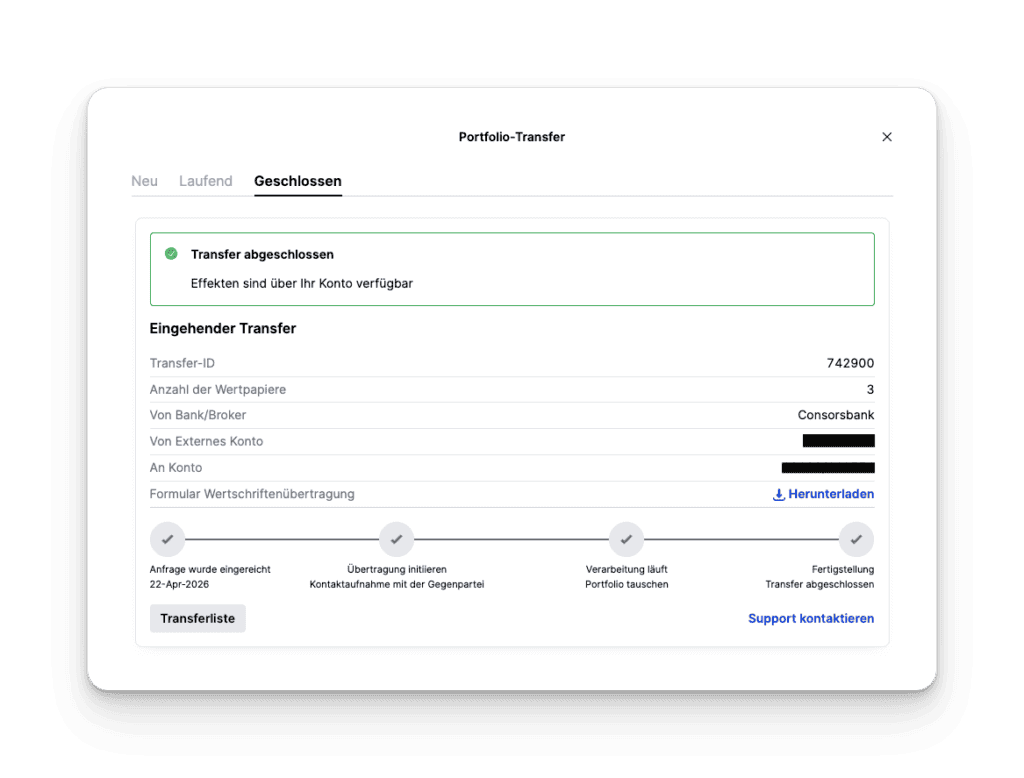
Nine days. That’s how long it took to transfer my portfolio from Germany to Switzerland. The request was received by Consorsbank on 13 April, and by 22 April the positions were with Saxo Bank Switzerland. There was just one hiccup. I was a bit lazy there, and that’s exactly the mistake you can avoid.

I didn’t pay anything for it. German banks are not allowed to charge any fees for the transfer itself. However, costs may still be incurred from third parties. This is possible when transferring money to Switzerland.

I’m sharing what I’ve learnt from this here.

I’m describing my own situation. The process is essentially the same with other brokers; only the terminology and forms differ.

Table of contents

Key points at a glance

  • Your German bank is not allowed to charge any fees of its own for the transfer. Third-party costs may still be incurred. This is a German peculiarity and not EU-wide law.
  • First, check whether your broker is willing to take part at all. Not everyone makes international transfers, and not everyone will keep you as a customer.
  • Normally, neither of these methods triggers a tax, Transfer and sell. Provided your Swiss address is on file with the broker. In exactly that order.
  • Nine days with me, From application to check-in. Allow two to four weeks anyway.
  • You should expect to have to apply to both banks. People don’t often point this out to you.
  • Later on, within Switzerland, it gets expensive, Usually between CHF 60 and 120 per position. Some brokers refund this when you switch.


Who pays for what?

Germany, outbound. On 30 November 2004, the Federal Court of Justice ruled in two judgements (XI ZR 200/03 and XI ZR 49/04) that German banks are not permitted to charge their own fees for the transfer of securities accounts. The reasoning is simple: your securities belong to you, and the bank must hand them over. It may not charge any money for fulfilling a statutory obligation.

However, there may still be genuine costs incurred by third parties. Your securities are held by a custodian, known as a depository. When transferring them to Switzerland, the custodian usually changes, and the bank is permitted to pass on any costs incurred in the process to you. You should therefore ask for the total amount rather than just the transfer fee.

Switzerland, in detail. Many Swiss brokers do not charge anything for incoming securities. Don’t rely on this: check with your chosen broker beforehand to see whether the transfer is free of charge and whether they accept all your securities at all.

Important: This charging rule is not EU-wide legislation. Germany is the exception. Anyone with a securities account in France or Italy usually pays per position.

Costs are therefore not usually a deciding factor in your decision. When switching from Germany to Switzerland, both options are inexpensive; selling through a German broker typically costs around EUR 10 in commission. The decisive factor is therefore something else: which positions you wish to retain, and whether you want to be out of the market whilst making the switch.

Not every German broker is taking part

That’s the first thing you should sort out, because it can throw a spanner in the works for the whole schedule.

Not every German broker supports cross-border transfers. And some providers do not continue to manage accounts held by people who are not resident in Germany, but instead close them. This means you end up selling under time pressure, and time pressure is the worst possible guide when it comes to financial decisions.

Ask your broker two things in writing. Does he continue to manage your account if you’re resident in Switzerland? Does he carry out transfers to a Swiss bank? The answer will determine your entire schedule.

Established direct and branch-based banks are usually straightforward in this respect. With newer app-based brokers, it’s particularly worth asking.

Top recommendations for 2026

Your key to success! Discover our top recommendations from real testimonials.

The tax issue

For most ordinary investment accounts, the tax implications are less significant than they might initially appear. A transfer without a change of owner does not constitute a sale at all; it merely changes the place of custody. And, provided the transfer has been correctly reported, a sale does not normally trigger any tax liability, because Germany generally no longer withholds tax on price gains, and Switzerland does not tax capital gains on privately held securities, provided you are not classified for tax purposes as a professional securities trader.

One condition is crucial here: Your Swiss tax residence must be fully recorded with the German broker. As long as the broker lists you as being liable for tax in Germany, they may withhold capital gains tax on any sale.

The order is the whole trick:

  1. You can update your address with a German broker based in Switzerland online
  2. Enter your Swiss tax identification number – this is your AHV number
  3. Check whether the broker has actually registered it
  4. Only sell after that


Step 3 is the most important one. ‘Submitted’ does not mean ‘registered’. With most brokers, you’ll see this in your account details or profile. If you sell before this, you’ll have to claim back the tax deducted later.

It worked for me: I sold two old holdings in my German portfolio in March. No tax was deducted – just the order fee.

There are three special cases you should be aware of, however.

Firstly, German dividends. This is hardly mentioned in any guidebook and causes confusion when you receive your first tax statement. German capital gains tax is initially withheld on dividends from German shares. Under double taxation agreements, Germany is permitted to retain 15 per cent on ordinary portfolio dividends. You must claim back the excess amount from the Federal Central Tax Office; this does not happen automatically. The deadline is four years from the end of the year in which the dividend was received, and experience shows that processing takes a long time. Capital gains are tax-free, but dividends are not.

Secondly, major shareholdings and large fund positions. Exit taxation may apply in this case. This applies to direct shareholdings in companies of at least 1 per cent. From 2025, this will also apply to funds and ETFs if you hold at least 1 per cent of a fund or the acquisition cost of your units in a single fund amounts to at least EUR 500,000. For tax purposes, Germany then treats the departure as a sale, even though you have not actually sold anything. If any of your holdings come close to these thresholds, you should clarify the situation with a specialist tax adviser before moving.

Thirdly, ongoing German income. If you continue to receive income from Germany after moving, Germany may, under certain conditions, continue to tax that income during a transitional period. There is an important exception for work-related moves to Switzerland. Have this specific case assessed on an individual basis.

And here’s what you can expect in Switzerland: You file your own tax return. Dividends and interest must be included in your tax return, whilst capital gains on private assets are tax-free. One point that is often overlooked: your German securities account must be included in your Swiss securities register, even before the transfer takes place.

What to stream, what to sell?

I had 14 holdings in my portfolio, including a few dead weight from my early days as a beginner.

Selling contaminated sites. What matters is not whether a position is showing a profit or a loss, but whether it still fits with your current strategy. If you wouldn’t buy it today, its past performance is no reason to hold on to it.

Transfer key positions. Broadly diversified ETFs and securities with a clear holding strategy are transferred directly as a transfer in kind. No sale, no tax, and no gap in market exposure when re-entering the market.

For most people, a passive ETF approach is the better option, and the move is a good time to switch to it. The following shows exactly how this works: Guide to ETF Savings Plans. And if you think that a single All-World ETF is a strategy in itself, read this contribution.

Will everything remain tradable?

In practice, this is usually the case with a German securities account.

Ordinary listed shares are generally less complicated than funds or structured products. However, the chosen broker must be able to hold and trade the shares.

With many funds and ETFs, a transfer is also possible, and for a reason that hardly anyone mentions: your German broker was only allowed to offer you products with EU documentation anyway. A German investment account therefore mainly contains UCITS funds from Ireland or Luxembourg, and these are commonplace in Switzerland. However, some individual funds may still be missing from your new broker’s range.

What happens in individual cases: You can hold onto a position and sell it, but you cannot buy more. This doesn’t matter for an existing position that you want to close out. But it does matter for a fund into which you want to make regular contributions.

That’s why this is the one check that’s worth doing: Before submitting your application, search for each fund you wish to continue investing in, using its ISIN, in the search box on your future broker’s website. It takes five minutes. If you can’t find it, ask the broker whether it’s tradable and whether you can buy more shares. If the answer is no, it’s best to sell it through your German broker and start afresh in Switzerland with an available equivalent.

Our financial tips for 2026

"Intelligent people learn from the mistakes of others".

We have compiled our top selection for you from all our tests and experience reports:

The transfer form

Almost every German broker has its own form for transferring a securities account, some as a PDF to print out, others as an online order. The names may differ, but the details are the same everywhere:

FieldWhat you enter
Transferring accountYour account number with the German broker
Beneficiary bank BICBIC of the Swiss beneficiary bank
Recipient account number.Your account number with the Swiss broker
Transmission type«Without a change of creditor» or «own custody account»
Tax IDYour AHV number
PositionsEntire portfolio or individually selected securities

In my case, it was a PDF that was sent to Nuremberg by fax or post. Yes, fax.

Important points regarding «without a change of creditor»: This field determines the tax treatment. It indicates that you are transferring the assets to your own securities account and are not making a gift. If you tick the wrong box here, it will trigger a gift tax notification to the German tax authorities. It’s worth checking twice.

Where to find the four numbers

That’s the question I’m asked most often.

  • BIC of your Swiss bank: The quickest way is via our IBAN calculator in the «Search for BIC» tab. Simply enter the bank’s name; the data is sourced from SIX Interbank Clearing. An incorrect BIC may result in the order not being correctly routed or being rejected, so you should have it confirmed by the recipient bank before sending it.
  • Account number with the Swiss broker: After logging in to the trading platform, usually in the top right-hand corner or under ‘Account Information’.
  • Account number with the German broker: on every custody account statement, usually in the top right-hand corner, and in the app under ‘Custody Account Details’.
  • AHV number: Thirteen digits long, starting with 756. It can be found on your health insurance card, your AHV card or your payslip. For private individuals resident in Switzerland, this is their tax identification number, which the German broker records as a foreign number.

transferring a shareholding from Germany to Switzerland: experiences, costs, fees, tips

How long it takes: my timeline

Most articles mention «two to four weeks» and leave it at that. Here’s how it actually went for me. The duration depends on the combination of brokers, but the sequence is typical:

timeWhat happened
Dispatch dateForm sent by post from Switzerland to Consorsbank
13 AprilConfirmation of receipt by email, two working days after dispatch
in betweenStatus message «In progress»
in betweenA note to the effect that I must also submit the application to the recipient’s bank
22 AprilPositions booked with Saxo

Nine days From receipt of the application to registration, it took around two weeks from the date the form was sent. Much quicker than I expected.

And a word of praise where it’s due: Two working days after it was posted from Switzerland, the confirmation of receipt arrived in my inbox. For a letter sent across the border, including the tracking process, that’s quick, and it takes away exactly that sense of uncertainty you feel after posting it. Sending a form by post and then hearing nothing for weeks would have been the more unpleasant part.

The surprise: you often need to submit two applications. I thought everything had been sorted by filling in the form at the transferring bank. Consorsbank then got in touch to say that an instruction was also required from the receiving bank. With Saxo, this was done directly via the platform – just a few clicks. The processes vary depending on the combination of brokers, so I’d recommend submitting both applications in parallel right from the start. If you wait until the originating bank points this out to you, you’ll lose exactly that amount of time.

Have your purchase details to hand. When submitting the request on the recipient’s side, you will be asked for the purchase price, purchase date and quantity of the transferred positions. The broker does not need this information for the settlement process, but rather as a basis for correctly displaying the cost price and return at a later date.

And here’s my own mistake: I was lazy and didn’t fill in the fields properly. I see the result every time I open my investment portfolio, because the performance figures are still wrong to this day. Don’t be as lazy as me.

Get the details from your old investment account before you apply, so you’ll have them to hand when you’re filling in the form. It’s a real hassle to correct things afterwards. And if you really can’t find any details for an old holding, ask the broker you’re switching to how they handle such cases.

What you should still bear in mind: My nine days are just a rough guide, not a guarantee. Cross-border transfers involve more parties, and the more unusual the security, the longer it takes. During this time, you won’t be able to trade the positions with either broker. If there’s anything you want to sell in the coming weeks, sell it beforehand.

Our financial tips for 2026

"Intelligent people learn from the mistakes of others".

We have compiled our top selection for you from all our tests and experience reports:

Check the acquisition costs

When transferring the shares, the purchase price and purchase date should be included. In practice, this usually works, but not always. What’s more, the Swiss broker will ask you for this information anyway when you submit your application.

For you, as a Swiss private investor, the absence of a purchase price is not a tax issue, as capital gains on private assets are tax-free. It is nevertheless a nuisance, as without a purchase price your broker cannot provide a meaningful performance figure.

However, there is a second, more compelling reason to back up the data yourself. If you later transfer funds back from Switzerland to a German bank, you will only be able to provide evidence of the acquisition details by means of a certificate from the foreign institution. If this is missing, the German tax deduction on a subsequent sale will be calculated at 30 per cent of the sale proceeds rather than on the actual profit. This can be significantly more expensive than correct taxation.

My advice: Make a note of all purchase data yourself beforehand – either by taking a screenshot or exporting the data. After the transfer, check that it has been recorded correctly and keep the documents for your records.

Later: How much does it cost to move house within Switzerland?

So you can plan ahead, because here the situation is the other way round.

Swiss banks are not subject to any ruling prohibiting them from charging fees. According to the market survey carried out by the Price Supervisor on 28 April 2026, which examined 31 Swiss banks, the cost of transferring a Swiss security is CHF 60 to 120 per item. Two-thirds of the banks charge exactly CHF 100. So, for ten items, that’s around CHF 1,000, just to walk out the door.

Two things that affect you directly:

You’ll have to pay extra when travelling abroad. Several cantonal banks charge CHF 150 instead of CHF 100 for transfers to a bank abroad. So anyone moving away from Switzerland ends up paying the most. This is a reflection of your situation today.

And the lever that overrides everything: Some providers refund transfer fees if you switch to them. In its report dated 28 April 2026, the Price Watchdog cited Swissquote, PostFinance and Cornèrtrader as examples. You’ll need to check directly with the provider to see if a promotion is currently running and what conditions apply.

The rule of conduct is therefore simple. Before you do the maths, ask your chosen broker: «Will you cover my transfer fees, and up to what amount?» Only if the answer is ‘no’ is it worth doing the maths yourself. In that case, the rule of thumb is: sell off small existing positions and transfer large core positions. The reason for this is the federal turnover tax, which is payable again on both the sale and the new purchase.

A note on context: The figures from the Price Supervisor are based on a sample of traditional retail banks. Online brokers were not included in the survey and some of their rates are lower. If you haven’t yet found a suitable Swiss broker, you can find one in the Online broker comparison Switzerland.

Checklist

  1. Enquire with the German broker, whether it will continue to manage your account whilst you are resident in Switzerland and carry out transfers to Switzerland
  2. Enquire with the Swiss broker, whether incoming transfers are free of charge and whether all tracks are accepted
  3. Update your address and register your AHV number as your tax ID
  4. Check whether it has been entered. Only sell after that
  5. Open a Swiss custody account
  6. Funds into which you wish to continue making contributions, search for it using the ISIN with the new broker
  7. Selling contaminated sites, which no longer fit with the strategy
  8. Make a note of the purchase details and keep them safe, Screenshot or export
  9. Submit both applications at the same time
  10. After check-in Check quantities and cost prices
  11. German custody account until closure report in the Swiss securities register

Our financial tips for 2026

"Intelligent people learn from the mistakes of others".

We have compiled our top selection for you from all our tests and experience reports:

Conclusion on the topic of transferring securities accounts between Germany and Switzerland

If you’re moving from Germany to Switzerland, you’ll need to sort through your investment portfolio. Transfer the assets you want to keep. The rest should be sold beforehand.

For most investors with a standard ETF or share portfolio, this is the most sensible basic approach.

The main reason isn’t the fee, as both options are cost-effective when moving from Germany to Switzerland. It’s the opportunity. When you move, you’ll be reviewing your investment portfolio in full anyway, and once your Swiss residence has been correctly registered, you can usually close out any outstanding positions without incurring German tax liability and with manageable trading costs. This no longer applies when you next switch brokers within Switzerland.

The clean exception: Core holdings that you hold for the long term. You carry these forward because no fees are incurred in Germany, no sales take place and you remain invested throughout.

Your next step: Ask your German broker in writing whether they continue to manage accounts for people resident in Switzerland. Their answer will determine your entire timetable. And if you don’t yet have a Swiss broker, start by Online broker comparison Switzerland an.

No investment advice.

FAQ

A transfer to your own investment account does not constitute a sale and does not normally trigger any tax liability. It is important to note that there is no change of creditor.

For me, it’s nine days, from 13 to 22 April. Nevertheless, you should allow for two to four weeks during which you won’t be able to trade these positions.

It remains held with the German broker and has no effect if you no longer generate any taxable income there. You can set it to EUR 0.

In practice, this is usually the case, but it’s not guaranteed. Make a note of the purchase price and date yourself beforehand, and check after the transaction has been recorded to ensure they have been entered correctly.

Not usually – whole items are transported. You sell off any loose items beforehand, and some banks offer a removal service for this.

It may apply to direct holdings of 1 per cent or more in a company. From 2025, it will also apply to funds and ETFs if you hold at least 1 per cent of the fund or if the acquisition cost of a single fund is at least EUR 500,000.

Usually, yes. However, even with shares, the chosen broker must be able to hold and trade the shares, and with funds, additional purchases may also be restricted. Check the ISIN before submitting your application.

Sources for the figures: Price Surveillance PUE, «Market Review of Swiss Bank Account Fees», 3rd edition, 28 April 2026. Federal Court of Justice (BGH), judgements of 30 November 2004, XI ZR 200/03 and XI ZR 49/04. Section 19(3) of the Investment Income Tax Act (InvStG) as amended by the Annual Tax Act 2024. Federal Central Tax Office on the refund procedure under Section 50c of the Income Tax Act (EStG).

As at July 2026. Information provided without guarantee. This article is based on my own experiences of transferring a securities account from Consorsbank to Saxo Bank Switzerland. Processes, fees and tax rates are subject to change and may vary from one institution to another. Check the current terms and conditions with your provider. This article is not a substitute for individual tax or legal advice.

Financial author Eric Marschall certified investment advisor (IAF) independent financial expert Switzerland - certified financial expert switzerland
About the author

Eric is the founder of Schwiizerfranke.com and certified IAF wealth advisor. Since 2019, he has been helping Swiss citizens to organise their finances comprehensibly, independently and efficiently.

📌 Note: This article is for information purposes only and does not constitute personalised investment advice.

Write a comment

Your e-mail address will not be published. Required fields are marked with * marked.

Get your free
Investment Guidebook
receive!