 Skip to content


What is an ETF? ETF definition and explanation
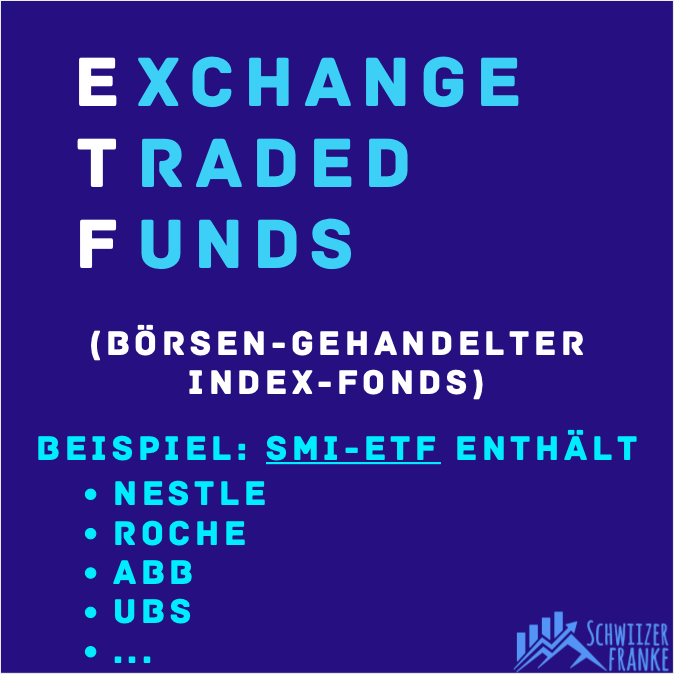
The ETF Definition is that of a stock exchange traded index fund. It is therefore a security that can represent any number of values and is traded on the stock exchange. ETF's are passively managed, i.e. an index (such as the Swiss stock index) is represented. In the example, this would be the SMI, which contains the 20 largest and most liquid listed companies in Switzerland.







Hello Eric
There is a Swiss dividend ETF: iShares Swiss Dividend.
Many greetings
Nadine
Hi Eric
Great article. I am 60 and want to retire to Thailand. I have approx chf 500k to invest and was considering an income ETF to get a steady return to live off. What would you consider in those circumstances? I already have some investments with Swissquote. Many thanks
Hi Mark,
there is not short answer to that. But you will find a good one in the FinanzFahrplan (in german).
Hello compliments for the site and good info.
What I haven't found are reviews on REIT and real estate ETF and homeownership as an investment mix?
The core satellite strategy is ok and well explained. I miss a bit the explanation of the risk / investor strategies such as Growth, Whealt, Income, Equity, Balanced etc. and how this is allocated in each case and what to pay attention to. Also a breakdown such as financial flow 50/20/30 etc. But maybe I just haven't found it yet?
The multiple account strategy is made more difficult by the sometimes outrageous fees charged by banks, not only in Switzerland.
As a Raiffeisen customer, you can do this largely free of charge.
I have always pursued the multi-account strategy, also with corresponding foreign currency accounts, but I will reduce them.
(My life partner was never really amused by this, probably wanted to consume more 🙂 )
Most of us often have no idea what assets we really have (AHV/PK) and what is in our PF and pillar 3a, and above all what fees we are being ripped off!
It's frightening when you realise after 20 or 30 years how big the growth really was and how 2-3% hidden fees per year have massively reduced the return. I am slowly solving these problems in retirement and shifting!
In particular, insurance and bank-owned active funds are very expensive and I don't know of any useful comparison portal. I would be grateful for any tips!
ETFs, on the other hand, are well documented and comparable on Just Etf and other portals.
In terms of securities accounts, Swissquote came closest for me in the price/performance comparison. In the end, however, I decided in favour of DEGIRO & FinanzNet Zero and am still looking at others. The most important criterion is "The profit is in the purchase" or in other words the lower the costs the higher the return. Then clarity and simplicity.
I trust the depositor protection abroad more than the 6 billion cap in Switzerland. In the USA, depositor protection is capped at $ 250,000.
It should be noted here that most people do not realise that deposits in pillar 3a and FZG accounts are not considered separately and are included in the depositor protection. If you have 300,000 in your FZG account, 200,000 is not protected. It is therefore essential to invest in securities in the custody accounts as special assets.
For payments to and from abroad, I have been using REVOLUT for years.
- A transfer from Switzerland of CHF 1000 to my CHF account abroad had me paying CS and Intermediaren Bank 3% fees.
cost. Both are EOL for me. With Revolut, it costs me nothing!
What I miss or even find annoying about investing in Switzerland are:
- Missing money market ETF in CHF
- Missing call money / fiduciary money ETF in CHF in small denominations
(Banks have a monopoly here and only offer it as a call cell from 200,000)
- Stock and bond exchange with small denominations (Fractal Trading)
(Would like to buy Lindth & Sprüngli, for example, but only a share at CHF 108,000 can be afforded by Krösus).
- that securities units from pillar 3a and FZG accounts often cannot be transferred to private assets at all or only to a very limited extent.
In the worst case scenario, book losses have to be realised at a bad price upon withdrawal/retirement.
It is therefore advisable to ensure that investments are made with ETFs and to make sure that it is possible to transfer them to any custody account.
- Tips for those who have to draw bridging pensions, supplementary benefits or social assistance.
Pillar 3a is taken into account and counted as an ASSET when consuming assets!
2. DO NOT use the PF credit as capital or withdraw it in advance, otherwise it may be immediately subject to the reclaiming of the legitimately withdrawn capital.
Social assistance/EL/UR offset.
3. anyone who is made redundant at 58 should consider the option of remaining in the PF and receiving a pension.
4. if you are unemployed (retired), you can split the capital of the PF FZG, withdraw it in stages and, if necessary, use it for an advance withdrawal or for self-employment.
Be sure to consult a counselling centre before signing any papers!
Hello, I would like to invest in the MSCI World and MSCI EM with the split 70%/30%. Since my savings rate is not that big, I would only invest quarterly 1500.- at Swissquote to not pay too many fees proportionally. I'm at the beginning there, how would you save the two ETF and how would you keep the ratio of both? Also, I saw that the trading currency is actually USD/EUR only. What is the best way to handle ETFs in other currencies that you want to buy (regarding exchange, etc.)?
Hello,
At Swissquote you can buy currencies directly and then invest in them. You will then be shown various positions in which you hold currencies. To avoid further fees, it is advisable to stay in these afterwards. If you receive dividends in USD, for example, you can reinvest them in USD securities or simply use accumulating ETFs.
Kind regards
I'm not quite clear about the impact of currency risk on an ETF. Most ETFs can be bought in EUR or USD, very few in CHF. If I have ETFs in USD and the Swiss franc gets stronger over time, does that depend on it or does it reduce the return?
Hello, Philippe,
It actually depends on what you intend to do with the distributions and ETFs. Diversification across several currencies is not a bad thing, because the franc can also perform badly. If the franc is strong, you can buy more favourably in foreign currencies. Of course, converting distributions from a USD ETF into francs reduces purchasing power. But you can also simply reinvest the dividends and wait for times when the switch is in your favour again. At least that's what we do. But at Swissquote you will find enough ETFs in Swiss francs, or where are you having difficulties?
Many greetings!
Hello Eric
I'm looking for a simple all-world ETF (or a world and an emerging market ETF) with a low TER (below 0.2 if possible), but I couldn't find it at Vanguard and iShares, or only the EUR/USD variants of these ETFs. Maybe I haven't searched well enough yet. What I want to protect myself from is a constant, slow increase in the Swiss franc against EUR/USD over the next 10-15 years. Or would the currency risk not be so great anyway, or is it hoped that the SNB will try to keep the exchange rate low in the future?
Many greetings
Hello, Philippe,
if you invest with Swissquote (?) you can take a look at the MSCI World ETFs there. Personally, I invest in one from UBS and an emerging markets ETF (roughly 80/20). Which I am quite happy with Gerd Kommer judge.
It is beyond my knowledge where the long-term monetary policy of the SNB is heading. If you think and invest for the long term, you should not forget about inflation and how many currencies have failed in the long term. Not to mention the current monetary policy.
Diversification across currencies and asset classes can therefore certainly make a lot of sense - but this is not intended as an investment recommendation. In the current Wealth Letter ...I've gone into the subject in a little more depth.
If you invest with Swissquote, you are welcome to write me an e-mail and I will be happy to share my ETFs with you there.
Many greetings!
Hello, Eric,
Thank you for your reply. I am not with Swissquote, but I have checked with Gerd Kommer and will leave my ETFs as they are. I wasn't really aware of the concept of "fund currency", I somehow assumed that a fund that has USD as its fund currency, for example, buys all its shares in dollars. However, an MSCI World or a similarly broad index naturally has many different currencies, against whose exchange rate fluctuations I can only hedge at great expense. I will therefore continue to invest in ETFs that seem sensible to me, regardless of the fund currency. Thanks again for your help!
Many greetings
Philippe
Hello Eric
Which two ETFs do you have?
Check it out here 🙂 https://www.schwiizerfranke.com/etf-strategie-core-satellite